
Introduction
Bangalore Express is an original composition that brings together Hindustani classical music, African musical practice, Afro-Cuban rhythm, and Brazilian harmony and rhythm, held together by the language of jazz. The piece follows an AABC structure and opens with an Alap, a tradition rooted in Hindustani classical music, before moving through sections that each draw on a distinct cultural and musical world. Rather than treating these traditions as aesthetic colours to paint with, the piece attempts something more considered: a genuine dialogue between musical languages that I have encountered through lived experience, direct collaboration, and years of study.
I grew up in India, where exposure to Hindustani classical music was not an academic exercise but a part of everyday life. That familiarity with raga, drone, and the improvisational logic of Indian classical music forms the foundation on which Bangalore Express is built. During my third year at university, I had the opportunity to work with Gustavo Andrade as part of the Contemporary Jazz Orchestra, an experience that gave me a direct and practical understanding of Brazilian rhythmic and harmonic language. Studying jazz at conservatoire has provided the framework that allows these influences to speak to one another: jazz, with its own deeply intercultural roots, is uniquely suited to that role.
The central argument of this essay is that intercultural composition is most meaningful, and most honest, when it is grounded in direct experience rather than surface borrowing. This essay traces the compositional decisions behind the piece section by section, reflecting on what was borrowed and why, and what jazz provides as the connective tissue that makes the dialogue possible.
Alap
The piece opens with an Alap; a tradition rooted in Hindustani classical music in which a soloist explores the melodic framework of a raga freely and without rhythmic accompaniment. As Rao (1999) describes, the Alap serves as an introduction to the raga’s character, mood, and melodic possibilities, establishing the emotional world of the music before any fixed rhythm or composition begins. In Bangalore Express, this tradition is adapted for a jazz ensemble context. The saxophonist improvises over a C drone while the rhythm section provides texture rather than groove, the drums playing airily on cymbals with occasional rolls and fills, and the congas and clave offering soundscape rather than pulse. The effect is deliberately unmetered and open, preserving the essential quality of the Alap as a space outside of fixed time.
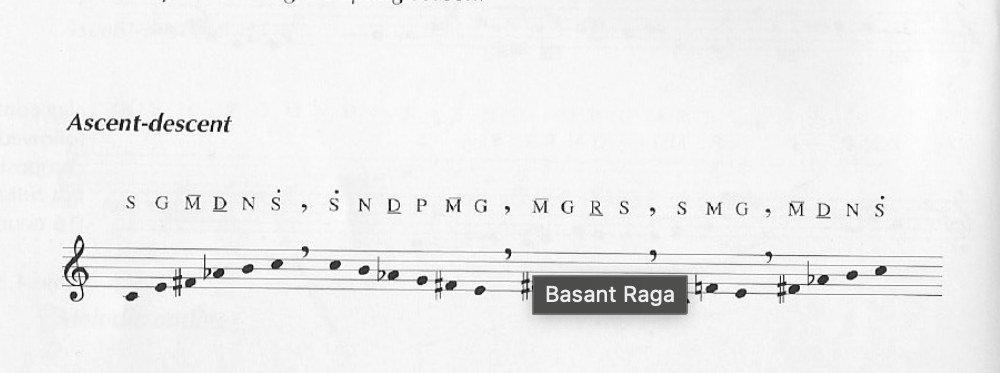
The raga chosen for this section is Basant, transposed to C as its root. Basant is one of the older ragas in the Hindustani tradition, its name derived from the Sanskrit Vasanta, meaning spring, and associated with the joyful Holi festival and the bittersweet longing of separated lovers reuniting during this colourful time of year (Rao, 1999). I composed Bangalore Express during springtime, and the choice of Basant was a direct reflection of that. The raga felt like the most honest and personal vehicle for the piece’s opening statement, carrying the emotional associations of the season in which it was written. Growing up in India, my familiarity with Hindustani classical music is not purely academic; the raga’s character and its cultural resonances were felt as much as they were understood technically.
I provided the saxophonist with a sheet outlining the raga’s scale, its characteristic phrases, and its ascending and descending movements, inviting him to improvise freely within that framework. The key adaptation lies not in the improvisation itself, which is simply the nature of the Alap, but in the instrumentation and texture surrounding it. In a traditional Hindustani instrumental performance, the Alap is accompanied only by a drone instrument such as the tanpura, with the tabla remaining silent until the composition begins. Here, the rhythm section remains present but deliberately restrained, providing an atmospheric soundscape rather than pulse or groove. It is in this space between the openness of the Hindustani tradition and the ensemble language of jazz that the piece first establishes its intercultural voice.
The transition out of the Alap is itself the first instance of a structural device that runs through the entire piece. Five high octave C stabs signal the end of the free section and mark tempo, while cueing the written bridge phrase designed around the Basant raga. This phrase, composed rather than improvised, acts as a bridge between the open world of the Alap and the rhythmic certainty of the A section that follows. The use of a signalling phrase here, rather than a written bar of transition or a tempo marking, is a deliberate borrowing from African musical practice, where specific rhythmic and melodic cues communicate structural shifts to performers and audiences alike. This principle, introduced here at the very opening of the piece, becomes the primary formal language of Bangalore Express as a whole.
A Section
The A section marks the transition from the free rhythmic space of the Alap into a structured cyclical metre. Although the section could broadly be interpreted as being in 7/8, I conceived it instead as a longer fourteen-quaver tala cycle grouped as 5-2-4-3 across two bars. Rather than notating the passage in consistent 7/8, the phrase is divided across changing metres of 5/8, 2/4, 4/4 and 3/4, reflecting the way the rhythmic cycle is felt internally. This approach was consciously informed by the Indian classical concept of tala, where longer metric cycles are understood through internal groupings and stresses rather than through uniform bar structures. As Reina (2016) argues, applying non-Western rhythmic frameworks to contemporary composition involves more than borrowing unusual time signatures; it requires adopting alternative ways of conceptualising pulse and structure themselves. In Bangalore Express, the tala is therefore not simply a rhythmic device but the organisational framework through which the entire section is heard.
The rhythmic tension within the section is created through anticipation and displacement. The piano articulates the beginning of the cycle clearly on beat one, functioning almost as a structural marker for the tala, while the bass deliberately avoids the downbeat and instead enters on beats two and three. This creates a feeling of suspended resolution and forward momentum, destabilising the listener’s sense of metric arrival. I was partly inspired here by the syncopated and interlocking rhythmic language found in West African music, where instrumental parts frequently articulate rhythms away from the primary beat to create propulsion and rhythmic elasticity (Locke, 1998). The anticipation on the fifth quaver of the opening grouping is reinforced through both harmonic hits and rhythmic accents, making syncopation a structural feature of the groove rather than an ornamental gesture.
The melodic language of the A section gives it an open, bright quality, with the melody diatonic to F major while the harmony takes on a Lydian colour through chords with raised fourth extensions; the Ab6 foreshadows this colour preemptively, as its third and sixth correspond to the #11 and major seventh of the Gbma7#11 that follows. The melody makes frequent use of C5 and C6 as recurring pivot points across its motifs: a subtle melodic thread connecting back to the C drone and Basant raga of the Alap, grounding the A section in a relative tonal centre despite its shift into a structured rhythmic framework. The antecedent phrase begins on beat one of the 5-2 grouping, with offbeat accents on the 5th and 6th quavers reinforced harmonically by Ab6 and Gbma7#11 landing on those same offbeats, unifying the rhythmic and harmonic language into a single gesture. The consequent phrase begins on beat three of the 4-3 grouping, with its ending varied across three iterations: moving from a straightforward three-crotchet articulation in the first, through a displaced offbeat accent in the second, to two dotted crotchets in the third, creating a hemiola across the final three beats, with Am7 and Bbsus4 landing as dotted crotchet harmonic hits that mirror the melodic rhythm precisely. As Sankaran (2010) notes, the manipulation of internal groupings within a fixed cycle is central to South Indian rhythmic practice, where displacing accents across a tala creates tension and release without ever abandoning the underlying pulse. This is precisely the effect sought here: the consequent phrase destabilises the metric feel across its iterations before the fourth and final statement opens out into a straight 4/4 bar, a different motif replacing the 3 grouping entirely and preparing the ear naturally for the samba groove of the B section.
Signalling Phrase
One of the most distinctive compositional decisions in Bangalore Express is the use of a recurring signalling phrase to demarcate structural transitions throughout the piece. While the phrase is written into the score and performers are fully aware of its placement on the chart, its conception was drawn from a principle found widely in African music and dance: a specific, repeated gesture that communicates structural shifts through sound alone, without relying on the kind of transitional conventions (tempo markings, bar rests, written cues) typically found in Western notation. This device runs through the entire AABC form, always played by the piano, and always identical in character; a deliberate choice that gives the piece a unified formal language rooted in a non-Western communicative tradition.
The conceptual foundation for this device lies in the relationship between music, dance and language in many African cultures. The treatment of music and dance as entirely separate art forms is largely a European distinction; in many African languages, a single word encompasses both concepts simultaneously. In Kiswahili, for example, the word ngoma can mean drum, dance, dance event, or music depending on context, reflecting a worldview in which sound and movement are inseparable. It follows naturally from this that structural transitions in African music are often communicated through embodied, performative cues rather than through written notation, as seen in the video below. As Locke (1998) describes, idiomatic bridge passages in African drumming serve as rhythmic and choreographic signals to both dancers and performers, marking shifts in the orientation of a piece without interrupting its cyclical flow. This is precisely the conceptual role the signalling phrase performs in Bangalore Express.
Chernoff (1979) describes learning African music as a process of responding to gestures and bodily cues, understanding what to do before learning how to think or talk about it. This captures something essential about how the signalling phrase operates in this piece from the listener’s perspective. Although the phrase itself is fully notated and rehearsed by the ensemble, the listener experiences it as a recurring sonic cue that announces structural change through recognition rather than explanation. This duality, formally written yet perceived as spontaneous and communicative, reflects a broader compositional commitment to engaging with borrowed traditions thoughtfully rather than superficially. The signalling phrase does not merely reference African musical practice; it attempts to recreate one of its communicative functions within a contemporary jazz composition, acting as the structural thread that binds the piece’s contrasting musical worlds together.
B Section
The B section moves into a distinctly Brazilian soundscape, marking the most dramatic shift in cultural and rhythmic language within the piece. The drums establish a samba groove with a strong emphasis on the partido alto pattern, while the piano and clave reinforce this rhythmic framework through interlocking partido alto comping. As Mauleón (1993) describes, the partido alto is a syncopated rhythmic cell that functions as a foundational comping pattern in Brazilian music, creating a layered rhythmic texture through the interaction of multiple parts rather than through a single dominant pulse. The congas accent beats two and four of the bar, and the bass plays a bossa nova inspired bassline, grounding the section in a distinctly Brazilian rhythmic feel while leaving space for the harmonic and melodic language above it. The harmonic language moves through two distinct sequences: opening with Ebma7, E7#11, Fm6/9 and E7#11, before moving into a chromatic descent through Dm7b5, Eb7, E half-diminished and Eb7. This kind of chromatic bass movement beneath a relatively static upper harmonic structure is a defining characteristic of Brazilian jazz writing, heard across recordings such as Triste and Wave from Jobim’s 1967 album Wave, as well as in João Gilberto’s Bésame Mucho from Amoroso and throughout the Getz/Gilberto album. These recordings, alongside Baptiste Herbin’s Vista Chinesa, formed an important part of the listening that shaped the sonic direction of the B section, not only in terms of harmonic language but in the overall textural relationship between bass movement, extended chord colours, and melodic phrasing above the groove, as seen in charts below.
A significant feature of the B section melody is its repeated emphasis on the #11 extension, reinforcing one of the defining harmonic colours of the section. The note F also functions as a recurring pivot point throughout the melodic phrasing, creating continuity across the shifting harmonic environment beneath it. The saxophone also makes use of the flattened fifth as a melodic inflection, a device rooted in hard bop and blues vocabulary that sits in productive tension with the Brazilian harmonic language of the accompaniment. This combination of jazz melodic language over a Brazilian rhythmic and harmonic framework was partly inspired by Lee Morgan’s Ceora (1965), a piece that similarly places jazz phrasing and chromatic melodic movement within a bossa nova context. The saxophone line adopts a looser, more jazz-oriented rhythmic character that floats across the accompaniment, so that the groove and melody operate in partial tension; different musical traditions occupying different structural roles simultaneously.
The section culminates in a Dbma7#11 chord sustained for seven bars, creating a prolonged harmonic plateau over which the saxophone melody reaches its climactic point before the signalling phrase returns to mark the top of the form for the piano solo. This interaction reaches a climactic point when the saxophone sustains a written F5 over the prolonged Dbma7#11 harmony near the end of the section. At this moment, the piano gradually moves away from the stricter partido alto comping pattern and adopts a more open rhythmic approach. The release of the repeated groove pattern creates a temporary suspension of rhythmic density, allowing the sustained melodic tension of the high F to become the primary focus before the return of the signalling phrase. The signalling gesture then reappears in the piano, reconnecting the B section to the broader structural language of the piece and cueing the return to the AAB material for the piano solo.
My understanding of Brazilian rhythmic and harmonic language developed through working with Gustavo Andrade during the Brazilian Contemporary Jazz Orchestra project in my third year at university. Through rehearsals and performances, I was introduced to a range of Brazilian grooves and styles including frevo, choro, lament and partido alto. This experience gave me a deeper understanding of how Brazilian rhythm functions within jazz contexts, particularly the relationship between groove, phrasing and harmonic movement. Gustavo’s rehearsal approach also influenced my compositional thinking. He often communicated rhythmic ideas aurally by singing phrases to the ensemble rather than relying solely on notation, which highlighted the importance of rhythmic feel and internalisation within Brazilian music.
Sample charts from CJO
C Section
The C section arrives after the piano solo, introduced once again by the signalling phrase. The ensemble moves into an Afro-Cuban groove centred on a Dm7 vamp, with Aalt functioning as a colour chord that adds harmonic tension without displacing the tonal centre. The clave establishes a 2-3 pattern and the bass plays a tumbao bassline, anchoring the section in the rhythmic and formal language of Afro-Cuban music. As Mauleón (1993) describes, the tumbao is a foundational bass pattern in Afro-Cuban music, characterised by its syncopated relationship to the clave and its role in creating forward rhythmic momentum within a static harmonic environment. Gerard and Sheller (1981) similarly note that the clave functions as the rhythmic spine of Afro-Cuban music, organising all other instrumental parts in relation to its two-bar pattern. The sonic world of the C section was partly shaped by listening to Ray Barretto’s Rican/Struction (1979), an album that demonstrated how Afro-Cuban rhythmic language could be placed in dialogue with more harmonically adventurous jazz writing without losing its rhythmic integrity or cultural grounding.
Over this static harmonic environment, the saxophonist takes an extended improvised solo. Rather than navigating a sequence of changing chords, the soloist is free to explore different scales, melodic shapes and implied colours over the sustained Dm7 centre, moving through different regions of the tonal space without the harmony shifting beneath them. This approach bears a close parallel to the logic of raga improvisation, where a performer explores the different routes, shapes and emotional registers of a raga over a continuous drone, implying different colours without the underlying pitch foundation changing. As Rao (1999) describes, raga performance involves the gradual revelation of a raga’s character through melodic exploration rather than harmonic movement, a principle that directly informed the conception of this solo section.
Following the saxophone solo, the drums and congas trade, eights then fours, twice through each, sitting on top of the tumbao and clave groove, which continues to operate beneath, so that the two traditions occupy different structural layers of the texture simultaneously. A further layer of this integration is found in the harmonic stabs of the Aalt chord, which are voiced to land on the three beats of the 2-3 clave pattern, embedding the clave’s rhythmic logic directly into the harmonic language rather than leaving it solely in the percussion. The tumbao feel of Gary Burton’s Ladies in Mercedes, from the 2004 Concord Jazz album Generations, was an influence here; its bass and piano interplay over a static harmonic centre demonstrated how a tumbao-derived groove could sustain energy and forward momentum through an extended improvised section. The signalling phrase then returns in the piano, marking the transition back to the A section and completing the AABC form of the piece.
Conclusion
Writing Bangalore Express was, in many respects, a process of discovery as much as composition. What struck me most was how naturally the different rhythmic and harmonic languages began to interconnect once I started working with them; the transitions between sections, the layering of groove and melody, the way the tala cycle sat alongside Brazilian comping all came together with a fluency I had not anticipated. The internalisation of these musical languages through listening, collaboration, and performance meant that the compositional decisions came intuitively rather than intellectually, which is perhaps the most honest measure of how deeply a musical tradition has been absorbed. The piece represents a starting point rather than a destination; each of the traditions explored contains layers of nuance and sophistication that a single composition can only begin to engage with, and I would want to delve more deeply into all of them in future work.
The broader question of intercultural composition is one that has been central to the development of music throughout history. As Clark (2002) demonstrates, genres such as Afro-Cuban music, Brazilian jazz and Latin fusion emerged precisely because musicians from different cultures encountered one another’s traditions and found new possibilities in the meeting. As Byrne (2012) argues, musical forms are always shaped by the social, cultural and physical contexts in which they develop; cultural encounter is not an interruption of musical tradition but a fundamental condition of it. My own position in relation to the traditions explored in this piece is not uniform; the Hindustani material is part of my cultural inheritance, while the Brazilian and Afro-Cuban languages were absorbed through collaboration, study and listening. What matters is the seriousness and depth with which a tradition is approached, and the honesty with which its influence is acknowledged. Jazz functions as the connective tissue that holds Bangalore Express together precisely because of its own deeply intercultural nature; a malleable and expansive framework that allows different traditions to coexist without flattening their distinctions, and to speak in their own voices within a shared musical space.
Bibliography
Byrne, D. (2012) How Music Works. San Francisco: McSweeney’s.
Chernoff, J.M. (1979) African Rhythm and African Sensibility: Aesthetics and Social Action in African Musical Idioms. Chicago: University of Chicago Press.
Clark, W.A. (ed.) (2002) From Tejano to Tango. New York: Routledge.
Gerard, C. and Sheller, M. (1981) Salsa: The Rhythm of Latin Music. Crown Point: White Cliffs Media.
Locke, D. (1998) Drum Gahu: An Introduction to African Rhythm. Gilsum: White Cliffs Media.
Mauleón, R. (1993) Salsa Guidebook for Piano and Ensemble. Petaluma: Sher Music.
Rao, S. (1999) The Raga Guide: A Survey of 74 Hindustani Ragas. Rotterdam: Nimbus Records with the Rotterdam Conservatory of Music.
Reina, R. (2016) Applying Karnatic Rhythmical Techniques to Western Music. Abingdon: Routledge.
Sankaran, T.S. (2010) The Art of Konnakkol (Solkattu): Spoken Rhythms in South Indian Music. Toronto: Canadian Scholars’ Press.
Discography
Barretto, R. (1979) Rican/Struction. New York: Fania Records.
Burton, G. (2004) Generations. Concord: Concord Jazz.
Gilberto, J. (1977) Amoroso. Los Angeles: Warner Bros. Records.
Gilberto, J. and Getz, S. (1964) Getz/Gilberto. New York: Verve Records.
Herbin, B. (2014) Vista Chinesa. Paris: Laborie Jazz.
Jobim, A.C. (1967) Wave. New York: A&M Records.
Morgan, L. (1965) Ceora on Cornbread. Englewood Cliffs: Blue Note Records.
