
Keith Jarrett and Charlie Haden’s recording of Body and Soul, from their 2010 duet album Jasmine, is a piece which should not be discussed without examining the greater context of the point in their careers in which it falls. The pair were frequent collaborators in the 1970s, with Haden featuring in Jarrett’s influential ‘American Quartet’ with Paul Motion and Dewey Redman, recording several landmark albums on both Impulse! and ECM (Iverson, 2009; Kobi, 2020), but Jasmine sees them returning to play together over three decades later, with a much older and more contemplative perspective. In the liner notes for the album, Jarrett states: “This is spontaneous music made on the spot without any preparation save our dedication throughout our lives that we won’t accept a substitute” and this reflects in the eight standards they play on the album, as the duo clearly intimately know each tune, which frees them play with the forms, and develop their own interpretations of these classic tunes (Jarrett has also argued that interpretation is a form of writing in and of itself (Kelman, 2010)), which we will see demonstrated on Body and Soul. Ultimately, the Jasmine project is a reflection on two prolific careers, and so it sees both players treading familiar ground, but bringing with them newfound experience and maturity (Grillo, 2010), which will become evident as we dissect Haden’s solo.
Part of the crux of this solo is Jarrett’s restraint with accompaniment- across the album we can see Jarrett and Haden’s empathetic approach to accompaniment, as Haden will often limit himself to semibreve root notes if the piano playing calls for it, and similarly Jarrett tends to let Haden go almost unaccompanied, save for some sparse piano chords for much of his solos. This can be simultaneously freeing and challenging for both soloist and transcriber, as the lack of another player leaves both harmonic and rhythmic responsibility solely on Haden, and leaving space, an essential part of the vast majority of jazz solos, suddenly becomes an authoritative change in timbre, from one instrument playing to complete silence, the entire existence of the piece left hanging in the balance. For the most part, Haden tends to avoid complete silence in his solos, but there is one interesting moment in the last A section of the form in which he chooses to pause for a moment (7:48):

As is typical of Haden, he treats the perfect cadences with a degree of subtlety, repeating the Bb and C on the dominant chord, in which they function as the 9th and 3rd, then leaving space at the beginning of the resolution to chord I, whilst continuing to develop the Bb and C idea, with them now being the major 6th and 7th of the chord, thus conveying the harmony in his characteristic horizontal playing style, whilst still leaving space for the tune to breathe. The motific use of just two repeated neighbouring scale tones can be seen all over Haden’s playing on this solo and beyond (Thompson 2024), for example later on in the last A (7:59):
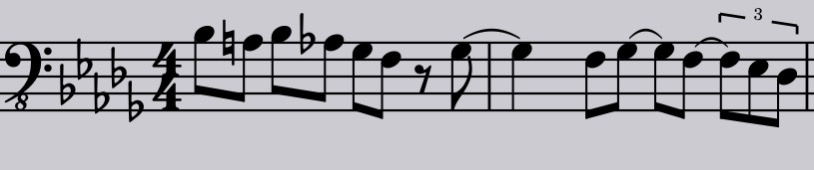
Or, to pick a different track from the album, this phrase on Where Can I Go Without You (6:17):
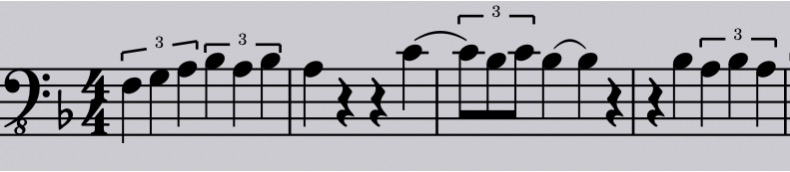
This expressive use of two notes serves to both give a strong melodic identity to the phrase, as he makes the most use out of two notes which he possibly can, sticking in the listener’s mind, whilst also naturally incurring dissonance and resolution, as inevitably one of the two notes will be a non-chord tone which wants to resolve back each time it is repeated. This is particularly effective with the 3rd and 4th, as we can see with the last 2 examples (likely because of the semitone or minor 9th clash which the 4th is implied to cause), but as demonstrated in the initial phrase, Haden can also use other chord tones, as well as using the same two notes for multiple purposes.
As we have discussed so far, Charlie Haden plays in a reserved manner for much of the Body and Soul solo, opting to get the most out of short, repeated motifs and scalic playing, however with the sparse harmonic accompaniment, and long sections to fill (Haden starts walking in double-time partway through Jarrett’s solo, so he effectively has 64 bars to play with) how does he avoid the entire solo feeling like a static diatonic mush? We can use the first few bars of the solo as a good example for how Haden clearly outlines the harmony through horizontal playing (6:07):
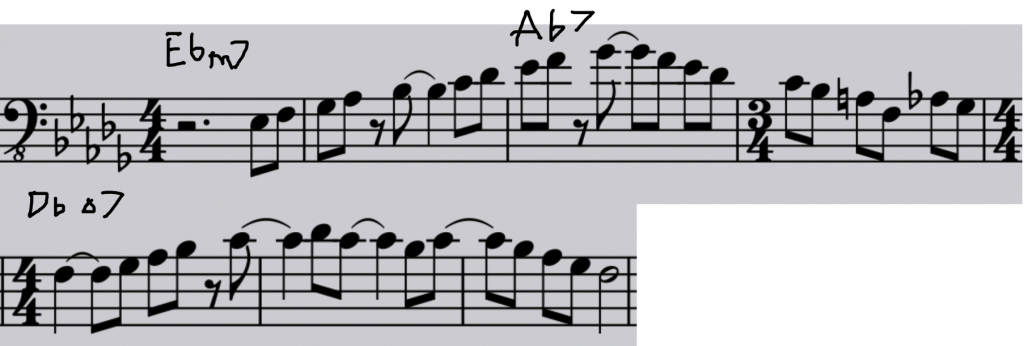
You can see that through the rhythmic phrasing of the lines he is playing, Haden begins each bar with a chord tone, and further suggests the dominant harmony with the use of harmonic minor language, the A natural acting as the minor 9th of the Ab7 chord. He also uses the repeated syncopated rhythmic motif on both the V and I chord, each time climbing to the 7th of the respective chord, before descending back to the 3rd (or the 5th of the Bb7 chord in the last bar, depending on your harmonic interpretation), emphasising the new harmonic world we find ourselves in each time the phrase is played. Haden then brings us back to the Ebm7 chord by substituting the Bb7 chord for an E natural, a technique which Jarrett also uses frequently on the track, but can be traced as far back as Coleman Hawkins’ iconic 1939 recording of the tune.
You may also notice the bar of 3 which I transcribed for this section; as well as additional license to play with the form harmonically, the presence of just one other player gives Haden and Jarrett the rhythmic freedom to let phrases run on as long as feels right, whilst not strictly tied to the bounds of a fixed metre. Despite this, the duo remain locked into the 4/4 groove of the tune, but in this instance it made the most sense to me to notate it this way, given the phrasing in relation the bars and harmony. It is also worth mentioning that Haden also uses this rhythmic freedom to shift between different quavers feels, often using straight quavers in order to push the tempo slightly quicker for rushed phrases (6:25):
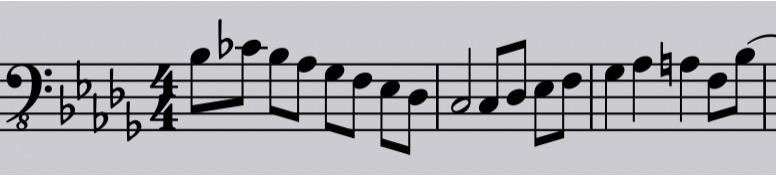
And swung quavers when he wants to really dig into the groove (6:40):

This expressive nature of the tune- the pushing and pulling of the feel and metre and the harmonic form, combined with the discipline and interplay between the two players ties into the central ethos of Jasmine, as referred to in Jarrett’s liner notes.
Those are the individual musical details which make up the notes and sound of the solo, but what about the contour and narrative of the solo as a whole? Haden’s solo is composed of a series of peaks and troughs in range and intensity, reaching a climax in the B section, before coming down at its natural point in the descending chromatic harmony passage back into the A section, where it settles back into a smoother swing in preparation for the head out. Some interesting comparisons can be drawn from each time the solo reaches a new ‘peak’ as it were, as Haden continuously ramps up the energy as the solo goes on. Starting at 7:01, the trajectory of Haden’s solo fluctuates from the lowest, most powerful notes on the E string, rising to the upper registers on the G string, firstly with this long-running enclosures passage:

Which effortlessly modulates to D major for the B section before descending with cascading arpeggios, in an interesting diversion from Haden’s usual conjunction style. The next time this grand ascent occurs it’s to an even higher interval, with Haden ascending 2 octaves up from the bottom F. This is the furthest journey he takes in terms of range, but keeping the rhythmic intensity at a high, Haden then breaks into semiquaver runs, a bold soloistic choice on a ballad such as this (7:36):

After this we approach the phrases I was analysing towards the start of this essay, with the solo mostly winding down, with Charlie incorporating some walking and double-stopping to indicate that the solo is reaching a close, but the solo thus far has already told such a varied narrative by this point that this is all he really has to say.
The Body and Soul solo was a challenge to transcribe and dissect, with its various harmonic and rhythmic subtleties which appear so seamless when read at face value, but it was an enriching one nonetheless, as this rendition not only shows what makes Charlie Haden such a special player, but also what makes his and Jarrett’s approach to music so life-affirming, as Keith Jarrett states: ‘[Music] doesn’t exist as a stationary object. It moves in real time and can be uplifting both to the player and the listener […] But it is not for us alone; it is also made for you, the listener, to feel these same feelings along with us, to participate and to also be uplifted by it.’
Bibliography
Keith Jarrett & Charlie Haden. (2010) Jasmine, Track 6 “Body and Soul”. ECM
Iverson, E. (2009) Interview with Keith Jarrett. Do The M@th.https://ethaniverson.com/interviews/interview-with-keith-jarrett/
Kobi, H. (2020) Keith Jarrett’s American Quartet, 1973-1976. Music Aficionado. https://musicaficionado.blog/2020/06/10/keith-jarretts-quartet-1973-1976/
Jarrett, K. (2010) Jasmine (Liner Notes). ECM.
Kelman, J. (2010) Keith Jarrett / Charlie Haden: Jasmine. All About Jazz.https://www.allaboutjazz.com/jasmine-keith-jarrett-ecm-records-review-by-john-kelman
Grillo, T. (2010) KEITH JARRETT/CHARLIE HADEN: JASMINE (ECM 2165). Between Sound And Space: ECM Records and Beyond.https://ecmreviews.com/2010/05/29/jasmine/
pdbass. (2024) The Most Unique Bassist in Jazz. Available online: https://youtu.be/hXbVAt_kL_4?si=5LzFH44PgHyKXecR
Keith Jarrett & Charlie Haden. (2010) Jasmine, Track 2 “Where Can I Go Without You”. ECM
Coleman Hawkins. (1996) Body and Soul, Track 4 “Body and Soul”. RCA
