
Introduction/Aims
In my Initial conversation with my students about their lessons, I asked them what Instrument they would like to learn most out of the instruments i felt confident teaching; Piano, Saxophone, Clarinet, Flute, Trumpet or Keyboards/Synthesisers. I had mistakenly presumed that the students would collectively like to learn Piano or Keyboards as they are the most visual instruments and help to solidify music theory knowledge. This meant that some of my research was void due to me being presumptuous, this taught me a valuable lesson early on and I sure not to assume in future lessons.
The students collectively chose to play trumpet due to all three of them having a major interest in Jazz music and also a lack of understanding on how the trumpet works as an instrument. I made sure to implement elements of Jazz and have a focus on teaching my students the physics behind the instrument.
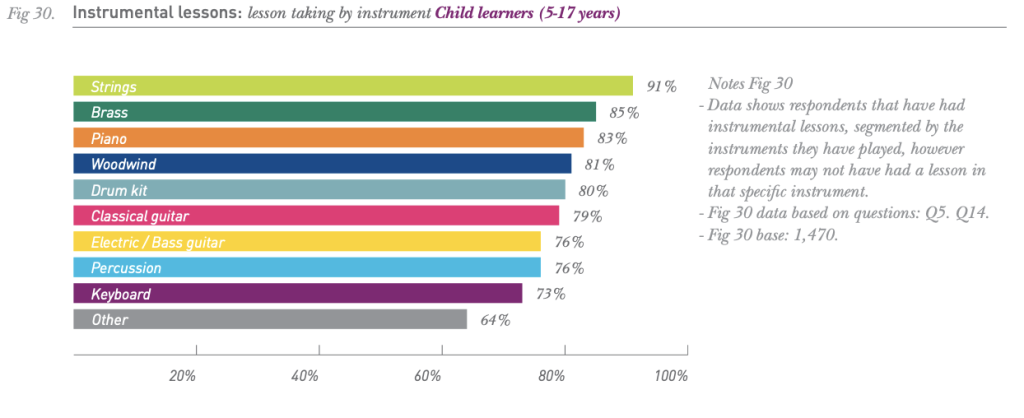
ABRMS 2015, Making Music: Teaching, Learning and Playing in the UK p26
This figure shows the instrument groups played by child learners in the UK who have had instrumental music lessons, with brass being the second highest instrument group.
According to makingmusic.org this is due to the popularity of Brass bands since the first world war that still impacts music education today.
It is important to note that the figure is provided by ABRSM who may not be a reliable source due to their focus on classical music which is often more encouraged by more affluent families. (BBC BOP Consulting, 2022)
Through these lessons I aimed to give a basic early understanding of the trumpet, how to improve their playing, self-diagnose issues and have fun while doing so with the hopes that this will enable the students to pursue the instrument and feel that they are able to express themselves through performance and improvisation in future. ‘This process is significant because it promotes autonomy, self-awareness, and a growth mindset, all of which are essential for musical growth and lifelong learning.’ (Lee, Sarah. 2025).
I would like the students to have an understanding of the scientific processes that the instrument harnesses to create the sound that it does so that they can begin to use typical and extended techniques in future, helping students continue to be excited by the trumpet throughout their journey with it. (Hutchinson, John. 2021)
The trumpet, even more so that other instruments, requires regular practice not only to improve but to maintain your level of skill and not regress. I hope in these lessons to show this, only advancing in each weeks lesson when I am sure we are picking up where we left off in the last lesson so that the students understand that those who practice daily tend to learn quicker, build endurance faster, and have a significantly improved tone quality. (Cruz, Javier. 2023)
I endeavoured to give as many ‘basics’ trumpet lessons as possible to three students: Callum, Matt and Dani. Callum plays the drums, Matt and Dani play the bass.
Considerations from context
Going into these lessons, I believe it is important to consider the context of my student’s interests, lives and backgrounds and how that may affect their learning and/or practice regimes. Things to consider may include musical experience and education, particular interest in genre or style, gender identity or social and financial class. This deeper knowledge can help teachers tailor their instruction, create a supportive classroom environment, and foster meaningful connections that enhance student success (Hamza, Muhammad. 2024). Not only was I familiar with many of these aspects of my students’ lives already due to shared projects and interests outside of this module but I made sure I had a brief interview with all students before their first lesson and also tried to encourage them to share with me aspects of their life they were comfortable with.
As all my students were boys, I wanted to make sure they were rewarded with enthusiasm for engaging with the subject as boys, in many cultural contexts, face peer pressure that equates academic engagement with weakness, discouraging them from investing in schoolwork. According to Anatole France, ‘Nine tenths of education is encouragement’.
(Teachers Institute 2025)
One of my students has to work a part-time job on top of their course so was not able to attend as many lessons as they would’ve liked. Despite this I made a continuous effort to check-in on them and their practice when i saw them around the university, clarifying any questions they had about the early stages of their trumpet journey.
All my students are already studying an instrument in a performance course at the conservatoire so I wanted to make sure to not over-explain any music theory concepts that they already knew and/or clarify with the students that i was not repeatedly explaining something they already knew.
For the same reason, all the students were already aware of the dedication it takes to learn and improve at an instrument (the most common reason to stop playing)
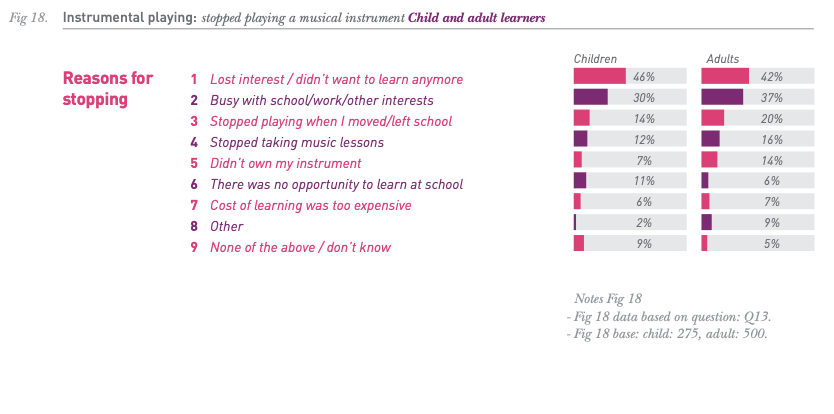
I predicted that a more pertinent problem would be the second most common issue, being busy with University work and other hobbies, as well as not owning an instrument, to try and appease this issue I clarified with the students that student trumpets were available from the facilities desk for all students to take out.
LESSON 1 Student A
Planning / Objectives
What should we do in those first couple of lessons? Their importance cannot be overstated. Pupils are at their most enthusiastic, so it’s a time to sow some quality seeds.
Harris, P. 2006. Improve your Teaching p49
It is Important that the students leave with knowledge about the trumpet, I plan to give them a tour of the instrument as well as Its parts and how they work. I want them to feel confident in their knowledge on how to learn and play the trumpet through teaching them how to hold the instrument and articulate correctly, according to my previous knowledge, teachings and by using the pedagogies of Max Schlossberg, Georges Mager and Arnold Jacobs (Luebke-Brown, Christopher 2018). They should also have Knowledge of the trumpet by the end of the lesson, such as when and why you would use a mute and Dizzy Gillespie’s unusual cheek tension technique, hopefully demonstrating that although most trumpet players play a certain way, there are technically no rules, it is whatever the student finds comfortable and fun.
I will use ‘The Suzuki Method’ by playing with the students as they practice techniques and ‘Dalcroze Eurythmics’ to help them be aware of how playing trumpet feels, this is very important for good technique going forward. (Zauss, Mark)
One of my primary goals for all of these lessons is to use my understanding of my students’ external lives to draw parallels between new and old knowledge as this technique of teaching is consistently helped me understand easier throughout my music education.
Execution
I began the lesson by evaluating where the level students may be at with trumpet or brass instruments in terms of knowledge, I thought that Callum’s minor background in Euphonium training might help me draw parallels for embouchure, I clarified this with him, and recapitulated what he remembered from this previous tuition, helping him to feel that he already has an understanding of the instrument and that progress is not too far away. (B. Hannah 2019)
I then demonstrated, trumpet in hand to the students, the different parts of the instrument, the science behind how it works and how moving the valves affects the pitch/frequency of both the fundamental frequency and harmonics above and below it. I made sure as I went to highlight some problems they may come across in their solo practice and how to fix them, such as opening the spit valve/s or fixing the tuning of the instrument, encouraging self assessment.
I had prefaced the lesson off-camera stating that they should feel completely comfortable asking any questions, no matter how silly they seemed, as an informal form of assessment for me, and to help clarify for them sections of information I had missed or skipped over. Callum made use of this, asking ‘Why are they (trumpets) made to be sharp or flat”. As both students were studying music at a conservatoire I did not want to oversimplify my answer, I also wanted to gauge an understanding of where both students were at in terms of there physics knowledge and so enquired about this which led to Matt demonstrating excellently one of the major parallels between his instrument and trumpet, clarifying how harmonics on a Bass and trumpet are similar.
At this point in the lesson, I wanted to make the most of their interest and inquiries, so tried to answer their questions to the fullest extent without skipping ahead beyond their understanding. I tried to demonstrate this with the sound of the instrument, as it is unanimous understanding that ‘sound before symbol’ or ‘music first’ approaches help facilitate music learning. (Eales, Andrew 2015-2026) I made sure to bring a mute to the lesson and demonstrate the sound of it as all my students were particularly interested in jazz trumpet, and the mute is an exciting way to drastically change the tone of the instrument that they may not have been aware of and my main goal for the initial lesson was to excite the students enough to look forward to next weeks lesson or maybe even do some practice.
For the main chunk of the lesson I wanted the students to understand what good technique sounds, looks and feels like. I also wanted to make sure they understood why it is so important that they get into good habits early on. I used humour and encouragement to get them comfortable making ‘bad’ sounds with and without the instrument in an attempt to break down learning anxiety issues. I emphasised that although good technique is important, it is also difficult and it is okay to struggle in the early stages of learning.
After the students gave ‘buzzing like a bee’ a go, I noticed both students were having issues maintaining an open, relaxed throat so went a step back, drawing parallels between daily life and trumpet technique to help them understand how playing trumpet should and shouldn’t feel. I also tried to subliminally demonstrate that airflow and deep breathing were essential, making sure to take an overly large breath before every example, or correcting myself when I didn’t.
I tried to implement the Suzuki method by playing with the students, giving an example and helping them to adjust their technique and tone to mine.
I finished the lesson by asking Matt and Callum to practice the articulation methods we had gone over, with or without a trumpet, hoping that without the restriction of needing an instrument they would be encouraged to practice more regularly. After this I began playing around on the trumpet, motivating them to do the same as I could tell they were both eager to play some intelligible notes before we finished, carefully criticising any technical mistakes that could lead to bad habits.
Reflection
The successes of this lesson were that both students said they enjoyed the lesson and were looking forward to practicing/playing trumpet. I had tried to keep the pace up for the whole 20 minutes so that they left feeling they had lots to do, without pushing them beyond their understanding and this seemed to pay off in excitement. I thought I demonstrated well the parallels between techniques they were used to achieving or were familiar with, such as ‘buzzing bee’ and comparison to Matt’s primary instrument.
If i were to do this lesson again I would perhaps be more confident in my knowledge. Despite the fact that this was due to me trying to maintain a ‘peer’ relationship with the students, research suggests that adult students need to feel safe educationally in the hands of the teacher, and that the teacher is knowledgeable enough for the student to trust their teachings. (Chew, Stephen L. 2023)
I also should’ve used audio recordings to demonstrate my teachings, encourage external listening and provide understanding on how the science of the instrument can be used in musical ways, such as playing a song like ‘The Last Post’ to show how tunes for brass have been written for the harmonic nature of the instrument.
If I had more time, or maybe in future lessons, I would try and find what about the trumpet excites the students, asking if they have heard one before, if they liked it, what genre did they like and/or how would they like to sound playing trumpet. If the student does not have answers to these questions it is also a fun and easy piece of homework for them to find music they enjoy listening to.
Although not all options were available, Ideally i would like to teach trumpet in a larger, more resonant room to demonstrate to the students how to ‘play to the space’, a key section of knowledge for trumpet players that may also teach them about performing in a wider sense, on their principal instruments.
LESSON 2 Student A
Planning / Objectives
The priority in this lesson is to recapitulate our previous learning and answer any questions the student may have since practicing alone. The first few practice sessions are often the most confusing as it is hard to self-assess and self-diagnose problems unless the student takes notes or records the lesson. If the student is able to complete this task we will move on to shifting harmonics with our lips. The goal is to play low C and middle G, then as a challenge Middle C. As we had recorded the previous lesson, I sent it to both students so that they could hear in hindsight the problems we found and the solutions then for them.
I will continue to use formative assessment to gauge the pace of the lesson and the understanding of the student.
Due to my self-reflection last week, I plan to be more assured in my skills in this lesson, hopefully helping the student to trust my knowledge.
Execution
As an introduction to the lesson, we did an informal assessment of how Callum had progressed or regressed since the last lesson, asking him to perform the practice task i had given him previously. I used examples and singing to communicate what I wanted him to do next as singing consistently helps students to understand musical tasks where speaking or playing can’t. (Musical Futures 2021)
Much of this lesson involved clarifying what we had covered previously, encouraging the student when they got something right and discussing the challenges of the instrument that they had found while practicing since the last lesson.
When initially playing long tones, I tried to play with Callum, helping him hear the intonation problems without criticising too heavily.
Callum became frustrated with the fact that he could not achieve what he previously had been able to, which for trumpet is a very common occurrence as facial muscle strength is a major factor in a trumpet players ability (Garcia, Jesse 2026). Despite this, he managed to keep going, feeling by the end of the lesson like he understood how playing higher should feel.
I finished the lesson by asking Callum to practice playing in a mirror, so that he could compare my lip technique to his, and self-assess to improve.
‘Blending the sense of ‘teacher knows best’ with the pupil feeling that they have
the time and space to make sense of knowledge and skills, is perhaps the most
effective approach.’ Shaw, Martyn 2026
Reflection
I realised watching the lesson back that due to the lesson being at 9am, both me and Callum were sat down, with bad posture, I made an effort to fix the posture but remained seated. This more than likely had a detrimental effect on Callum’s ability to play due to restricted airflow, posture is a very common reason for tension and struggle when playing (Emery Robert, 2024).
I also realised I wasn’t listening to Callum as well as I could have done, there was a couple of moments where he communicated to me he was feeling things that he wanted to know were right/wrong but I was so focused on the task that I continued the lesson, I should have stopped to clarify this with him.
Despite this, I was definitely more confident this week and Callum made important progress.
Future Lessons & Conclusion
In our next lessons I hope to begin playing melodies by ear initially, gaining control of the partial harmonics, before beginning to try alternate fingerings outside of open valves. Once the pupils are confident they can play notes with intention, we will improvise together over tunes with a simple harmonic base, ideally selected by the student to encourage play and find the excitement in improvising in trumpet. After 6 months of lessons I will invite friends to listen to them perform so that they have an achievable goal to work towards and a tangible motivation to practice. Preparing for a recital, showcase, or informal class performance provides a clear sense of direction (Loud and Clear Music School, 2026)
I would’ve liked to have recommended or listened with the student to a range of styles and traditions of trumpet music so that they understood the versatility of the instrument, Its nuances and unique attributes. As need adult sounding music as soon as possible and know they want to learn so will want to direct lessons.
Once the student feels able to play 12 notes with the intention of playing the same ones, we will put names to them, using both solfege (do-re-mi), number-names(1-2-3) and note-names (A-B-C). Once they are comfortable with this I will begin sheet music tuition and sight reading skills, encouraging the students to write, compose or improvise their own music using the trumpet and a daw/notation software/manuscript paper. This pupil-led teaching method helps the student find their voice and continue to be motivated to practice music.
My final goal for the student is to play trumpet in an ensemble as this is the best way to have fun while constantly developing your skills.
(Concord Conservatory, 2026)
I taught an auxiliary lesson to Dani, another bass player, using the same techniques as Callum and Matt, (due to Callum and Matt having ‘mouth fatigue’ or learning anxiety) seeing that he found the understanding and tuition much less frustrating due to his previous experience in trombone.
Overall, I believe my goals were achieved, Callum and Matt enjoyed their lessons and would like to continue tuition in trumpet playing, they said they learnt a lot not just about trumpet but the physics behind brass instruments.
References
ABRMS 2015, Making Music: Teaching, Learning and Playing in the UK
Teachers Institute 2025. Environment influences learning outcomes
MakingMusic.org 2025 introduction-brass-bands
BBC, 2022. Classical Music Ecosystem Research
Lee, Sarah. 2025 mastering self assessment
Hutchinson, John. 2021 So You or Your Kid Wants to Play the Trumpet
Cruz, Javier. 2023 17 Ways to get better at playing trumpet
Hamza, Muhammad. 2024. things-teachers-should-know-about-their-students
Harris, P. 2006. Improve your Teaching p49
Luebke-Brown, Christopher 2018. The Foundations of Modern American Trumpet Pedagogy
Zauss, Mark. The Psychology of trumpet playing
B Hannah, 2019. How to practice a second instrument
Eales, Andrew 2015-2026 Sound Before Symbol, Lessons from History
Chew, Stephen L. Student trust in the teacher: An overlooked but critical factor to success
Musical Futures, 2021. Why It’s more important than ever to include singing in the classroom
Garcia, Jesse. 2026 Trumpet lips feel different after a break
Emery, Robert. 2024 Trumpet playing and Posture
Loud and Clear Music School 2026
Concord Conservatory, 2026 10 Excellent Reasons to Play in an Ensemble
Cooke, C. (2011) ‘Promoting an inclusive musicclassroom’ in N.Beach, J.Evans & G. Spruce (ed.) Making Music in the Primary School: Whole Class Instrumental & Vocal Teaching . Routledge. Reflection
Weidner, Brian N. Brass Techniques and pedagogy
Swindler, Chloe. Trumpet Fundamentals
Chris, Trumpet Hub. Your First Trumpet Lesson
Conner, Jeff. 2021. Fix it: trumpet teaching tips
Forbes Music, 2024. Common types of music methodology for learning instruments
Scott, Fran. Foot, Greg. How Brass instruments work
Tremblay, Katie; Rose, Leslie Stewart 2023. Facilitating Inquiry in Music Education
