
EPK link: https://rolvinscionelson.my.canva.site
EPK Commentary
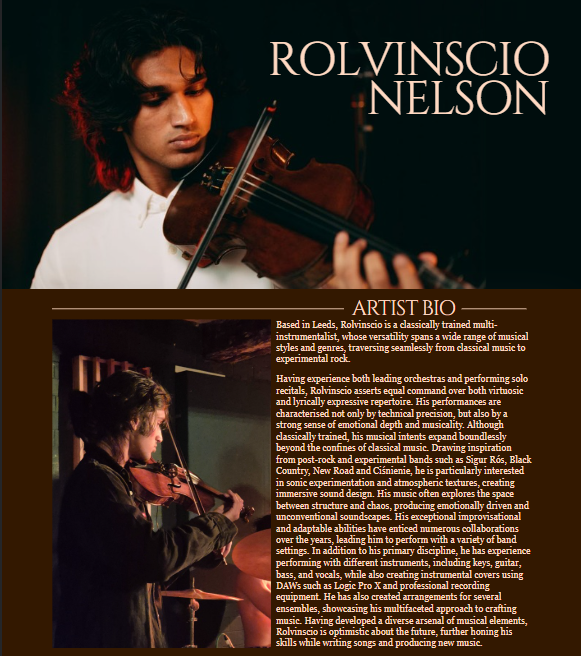
In the busy modern world, an Electronic Press Kit can be considered a necessary promotional and branding tool, allowing artists to effectively communicate their identity to their audience, potential collaborators and industry professionals. This commentary explores the creative decisions made in the development of my EPK.
The primary platform used for its creation was Canva. While I looked into alternative options, such as WIX and Bandzoogle, I preferred to use Canva since its free version is extremely user-friendly and still has most major features I would need for this project. WIX, for example, requires a subscription to link the website to a domain that would need to be purchased. As an artist that is not yet established, it seemed pointless to make such an investment. The decision to create the EPK as a website and not in a PDF form was influenced by the current marketing practices within the industry. A website is simply more interactive, which improves user engagement, and simpler to navigate with its integration of embeds and links.
It was difficult to find the format of EPK that we were tasked to design, since most EPKs found online are fully fledged websites. However, it was not too difficult to come up with ideas. Having discussed how to structure the EPK during a WITCI seminar, the ideas were there to implement. The seminar helped to establish the primary expectations, with importance on clarity and accessibility. Deciding the structure was the first part, and because I lack music releases, a major part of my content needed to revolve around the artist bio. While researching professional layouts and websites online, I found that many successful artists had a short artist bio. Following this, I had sectioned mine into two parts, a small condensed version only about 30 words, and a large section going into detail about my work. The small version was discussed during a WITCI seminar, and the main guidelines were that it had to communicate the artists identity quickly and clearly. As a result, it only needed minor tweaks before I added it to the EPK, however the large section was revised extensively, since I wanted to maintain a somewhat editorial-esque standard while keeping it natural and authentic. Since I have not officially released any music, the songwriting aspect was only mentioned as a sidenote at the end, to avoid diluting the overall idea. I did, however, include my classical music side about equally as much as my experience with other genres, balancing the two ends of my musical spectrum. The idea of versatility became the central focus of my bio, and consequently my overall EPK, influencing my picks for all the sections, trying to keep a mixture but not in an unfocused way.
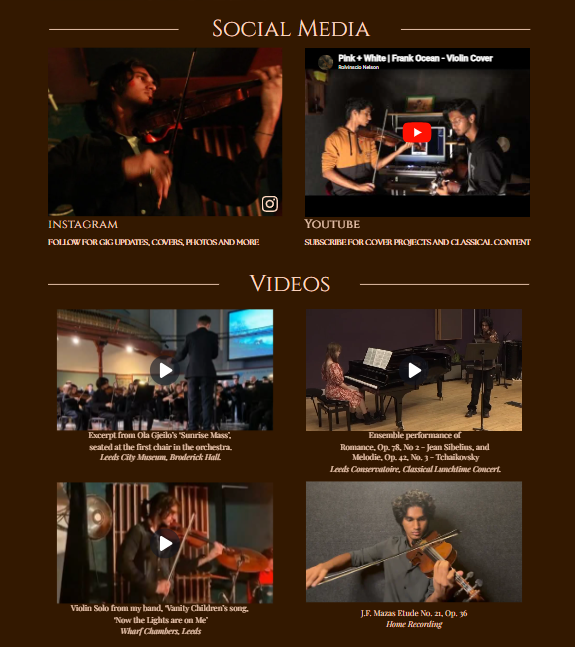
In the second section, I put two social media platforms, Instagram and YouTube, the ones I am most active on. They were chosen to largely represent the promotional and creative sides of my work, respectively (though there are crossovers). I formatted the YouTube video as an embedded video instead of a picture with a link I did in the later video section, because this made it easier to view my channel, and it immediately stood out as a YouTube video. Short descriptions were included below the embeds regarding what the viewer could find on said platforms. Instagram included for gig updates, short covers, photos, etc. and YouTube for long form content, such as large cover project videos.
In the next section, ‘Videos’, I picked 4 videos to embed based on the qualities established in my artist bio. An orchestral performance, a violin-piano duet, a violin solo from my band’s indie rock song, and a classical etude, each of them serving a specific purpose. Although the recordings are not of professional quality, I decided it was more important to showcase versatility rather than presenting overly polished material that did not represent me as a musician. The orchestral performance is a soloistic section from the piece to demonstrate my experience leading an ensemble. The solo is lyrical and expressive, since it is not rhythmically rigid, making it an apt example of phrasing and interpretative ability. Similarly, the violin-piano duet highlights collaborative work and communication within smaller ensembles. The indie rock solo proves my interest in music outside of the classical genre, and brings out a completely different side of the applications of my violin technique. Finally, the classical etude was chosen to demonstrate technical discipline and a strong foundation on the instrument. When put together, the videos create a broad representation of my musical identity. Canva sites are designed to autoplay the videos when the page loads, and unfortunately I could not disable this feature, so I instead ensured the videos were muted to not have a messy and loud introduction to the site.
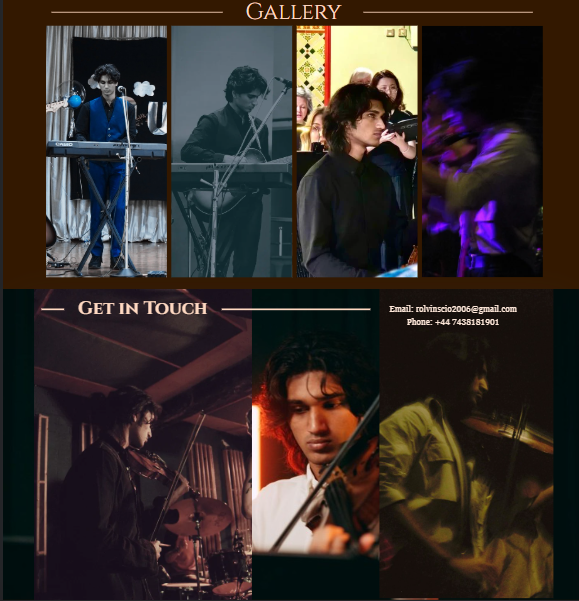
The next section in the EPK is a small gallery, that I added to further demonstrate my versatility through a multi-instrumental perspective. For this reason, I picked images of me singing and playing keys, and then playing guitar on the same stage. I intend to update these images when I have more options (like playing my other instruments), and a different layout. Most EPKs I viewed online had a gallery section, usually formatted as an interactive slideshow having pictures with a translucent arrow mark to click to the next picture, with approximately 5-6 pictures to scroll through. This format appears professional since it keeps the page visually clean. However, Canva does not offer this exact feature, so I did mine in a different fashion with the available tools. Instead of creating a slideshow type gallery, I laid out 4 static images and put filters on them to make them look appealing, and not too similar when viewed simultaneously. This solution worked effectively within the limitations of the platform, but if I am to create an EPK in the future more professionally, I would pick the slideshow, especially because I expect to have higher quality images/photoshoots. Other pictures I wanted to include in my gallery were instead used in other sections.
I kept the overall visual theme of the EPK simple and minimalistic, using easily readable fonts in order to maintain readability, particularly for larger blocks of text like the artist bio. In terms of colour, I selected a palette that is visually appealing, focusing on tones that support readability while still contributing to a polished, modern look. Picking a rich brown as the background avoided any stark contrasts between the content on screen, as most of the media used contained similar tones. Overall, these design decisions ensure that the EPK remains professional and easy to engage with. Finally, I included a small “Get in Touch” section, with my email and phone number in a light font, set against images with dark filters to make it easily findable. I also debated whether I wanted my contact details at the beginning or the end of the site. After much consideration, I decided I preferred the end because I liked how clean and uncluttered the first pages looked, and wanted to prioritise first impressions. Besides, for a small website that only requires a few scrolls, a viewer would likely assume that the contact details would be found at the bottom.
In conclusion, building this EPK gave me a clearer understanding of how an artist can be presented in a structured and intentional way. At the start, it was slightly difficult to define the format because most examples I found online were fully developed websites rather than simple templates. However, this pushed me to do more independent research and think more carefully about how professional EPKs are actually put together, and how I could adapt those ideas to suit my own work. One of the main things I learned was the importance of organisation and clarity. Breaking the EPK into sections such as the biography, videos, and gallery helped make the information easier to follow and gave the website a clearer sense of progression. I think the EPK does a good job of presenting who I am as a developing artist by showing a range of musical experiences. The key takeaway, mentioned frequently in WITCI lectures and seminars, is that the EPK is not a finished product, but something that requires periodic updation to stay relevant. It functions as a living document that grows over time, alongside the artist it represents.
Bibliography
Bandzoogle. https://bandzoogle.com/sample-epks [Accessed 8 May 2026]
Cara-C. Electronic Press Kit. https://www.cara-c.com/presskit/ [Accessed 8 May 2026]
Kreech, K. Electronic Press Kit. https://kariskreech.my.canva.site [Accessed 10 May 2026]
Leigh, C. Electronic Press Kit. https://www.christopherleighmusic.com/epk [Accessed 9 May 2026]
Lucky, M. Electronic Press Kit. https://static1.squarespace.com/static/658745c25eba4c7cd2b2860f/t/68d892fdbe746f013d02d44c/1759023869151/Marki+Lucky+EPK+Short.pdf [Accessed 8 May 2026]
Peszko, S. Electronic Press Kit. https://sebastianpeszko.com [Accessed 9 May 2026]
