
Introduction
During my first semester, I had the profitable opportunity to learn actor and text from Claire Eden and Tyrell Jones. We explored numerous techniques of acting throughout our lessons such as objectives, tactics, commanding, line repetition, as well as analysing and dissecting different texts. In this portfolio, I will be sharing my experiences with these methods and their value to my learning.
Objectives
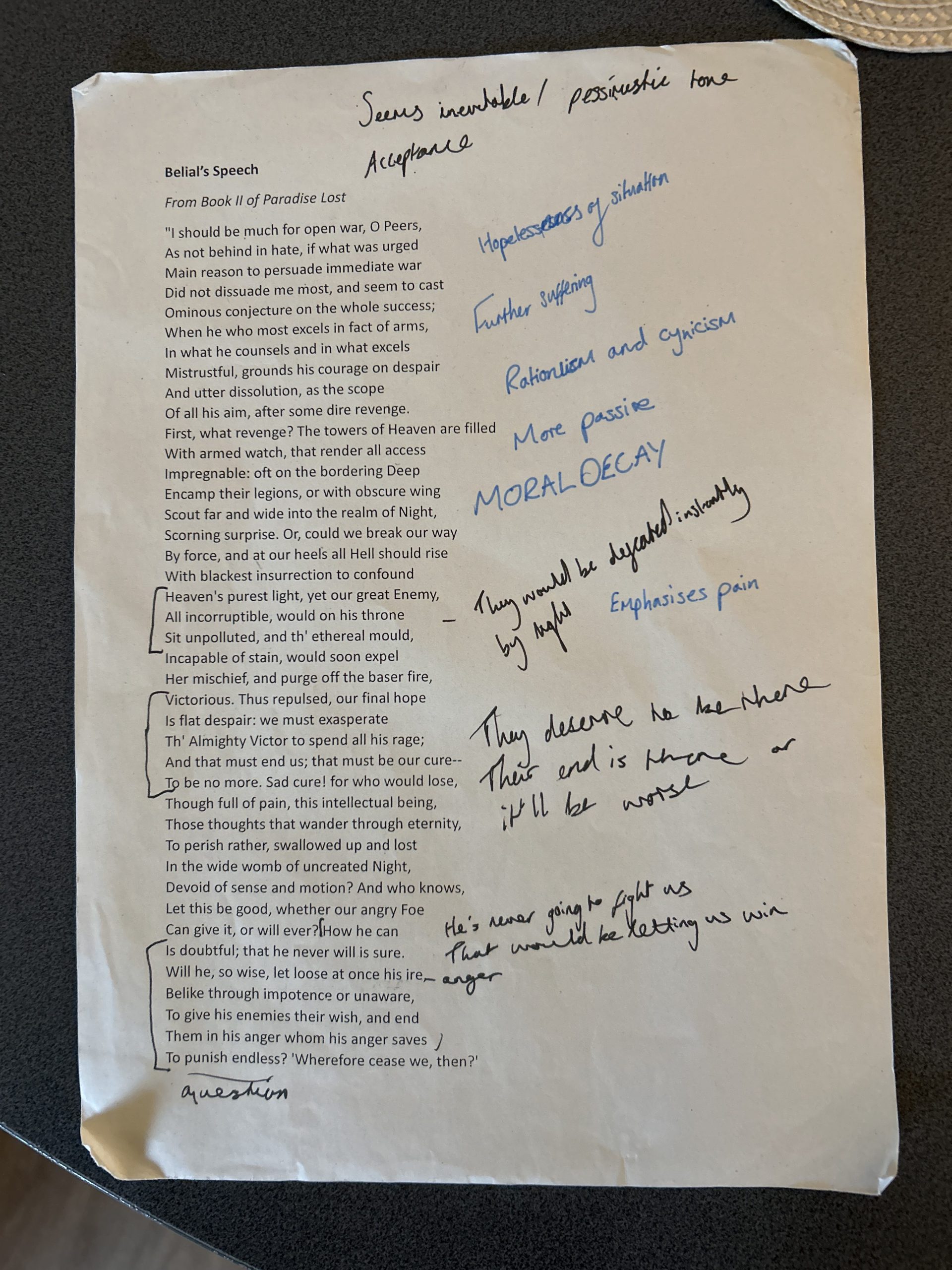
In our initial lessons with Tyrell at the start of the year, we learnt the importance and concept of objectives, a crucial method in the “Stanislavski Technique.. The concept of objectives is that of portraying one’s intentions and/or motivations while using characteristics of realism and emotions in order to convey a convincing performance (Ates 2023). It helps actors truly connect with their characters and is a way to help push the story forward with intention. During our first lesson, Tyrell introduced us to objectives through the speeches of the three fallen angels from the epic poetry narrative “Paradise Lost.”. Throughout this task, we each chose one of these three speeches and analysed which objectives were used by our chosen angel. At first, to my surprise, I found the task at hand quite difficult as I had severely underestimated how much analytical evidence I would need in order to find a valid objective from my angel Belial. It was made easier when we went into small groups with classmates who had chosen the same angel as me, and there we worked on finding objectives together. Once we had found common factors and metaphors in Belial’s speech, it came upon us that Belial was anti-war against God and that his objective was to convince the other fallen angels, Beelzebub and Moloch, that war was a bad idea and that they would gain nothing from war. This really altered how I viewed the character of Belial, as now I had found out his objectives; it gave me a wider insight into what his character is really like. This impressed me, as I hadn’t gone that deep into a character’s intentions before, and here I had learnt so much about a character just through one speech. What I found most interesting about the technique of objectives was really delving into the mind of a character and finding out what they wanted in that moment and how they would carry out their behaviour throughout the scene and the play as a whole.
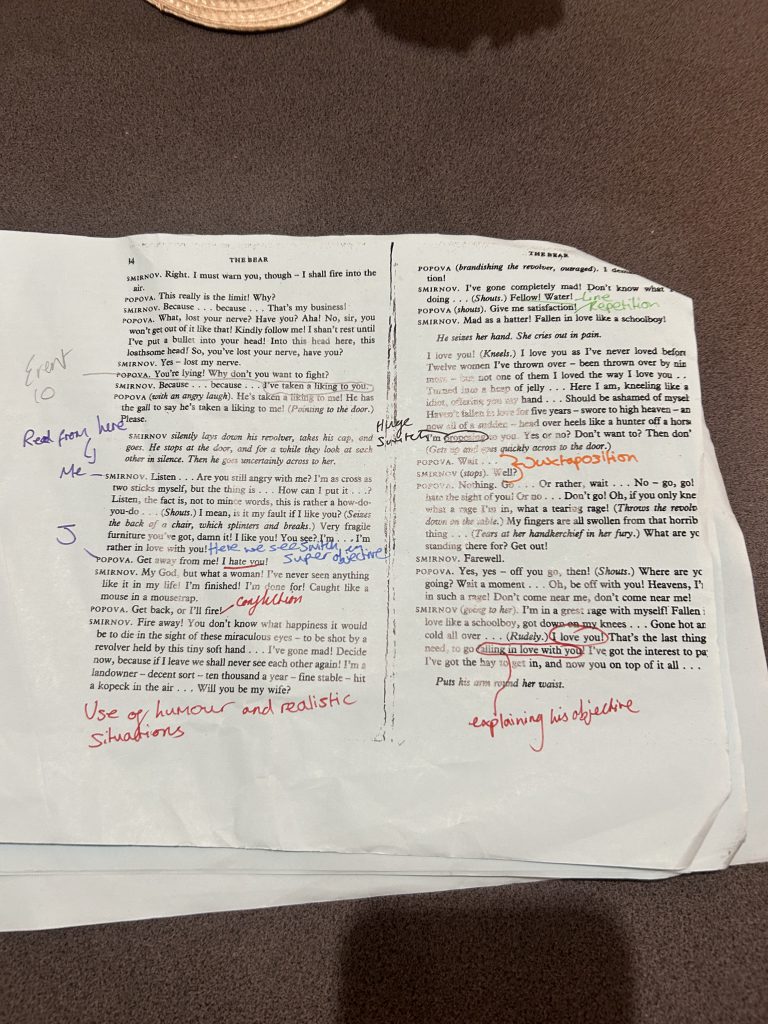
Subsequently, we submerged ourselves into Anton Chekhov’s masterpiece, “The Bear,” where we continued our exploration on objectives and added super objectives to our arsenal of methods. The difference between these two methods is that an objective is what your character wants during the scene, whereas the super objective is what your character wants more than anything throughout the entire play (Goodman, 2016). I undertook the task of researching the character of Smirnov, and I really enjoyed the complexity of this task. Throughout the play, his objectives change multiple times, but his super objective remains the same; however, it does become more complex. This is in the sense that his super objective is to secure his financial stability, but he becomes infatuated with Popova, therefore leading him to pursue her and settle his debt. Ultimately finding out that Smirnov’s super objective evolves to both his financial needs and his romantic needs was a very humorous discovery that made me really appreciate Chekhov’s work as a whole. His realism writing style, which focuses primarily on the actor’s and characters feelings and intentions, is genuinely inspiring, as well as his use of the foreshadowing technique (Hingley, 2019). I thoroughly enjoyed learning about the concept of objectives and the further expansion onto super objectives. It’s hard to realise what a character is thinking from just the script, so breaking down each line and each bit of context is so important in understanding a character. Then being able to use this essence in my performances of these characters really made it easier to understand what their intentions were, which made it really enjoyable to be progressing at such an early stage in our lessons. Overall, I think that these two methods that combine with each other are so crucial in our development as performers, and it’s very enjoyable when working through and building upon them.
Actioning
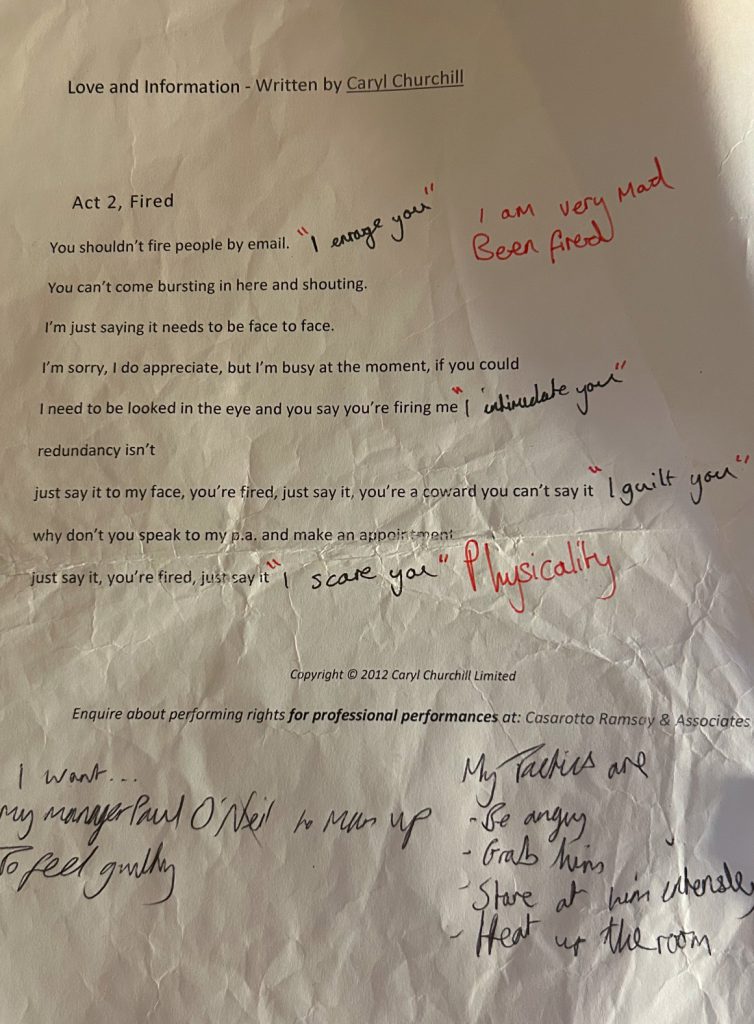
This was a very enthralling technique for me, as I had never come across one like it before, in the sense that I wanted to find out a lot more about this technique. The process of actioning involves “assigning an active verb to each of your lines to illustrate its underlying meaning or subtext”(McGowan, 2022) We initially began walking around the room, and on the count of three, we would say a line that involved the structure of “I (verb) you,” which I found a challenge, as I could not think of what to say in time or was not able to use a correct action that worked with the verb. There are multiple ways you could action a line, and I found it confusing as to which was the right action to use. I was explained by my teacher that there aren’t any wrong decisions which made the process slightly easier. I began to use a more visual effect to my actioning which definitely caused a shift in my performance and changed it from being the same, basic one it was before, which was nice to see. What i did enjoy about this technique was the noticeable shifting in all of our perfromances when we altered the intention of the verbs we used. For example, we would say our lines in a more exuberant tone and find an action to match, then we would repeat the line with a slightly more meagre, more disgusted tone and would have to come up with a new action. Most of the time, I found this technique quite difficult and didn’t understand how I could incorporate it into my skills, but it came to mind that you just use any action for any word and that it has to be thought about on a more personal scale which i thought was very interesting, and I can see why this technique is so important.
Line Repetition
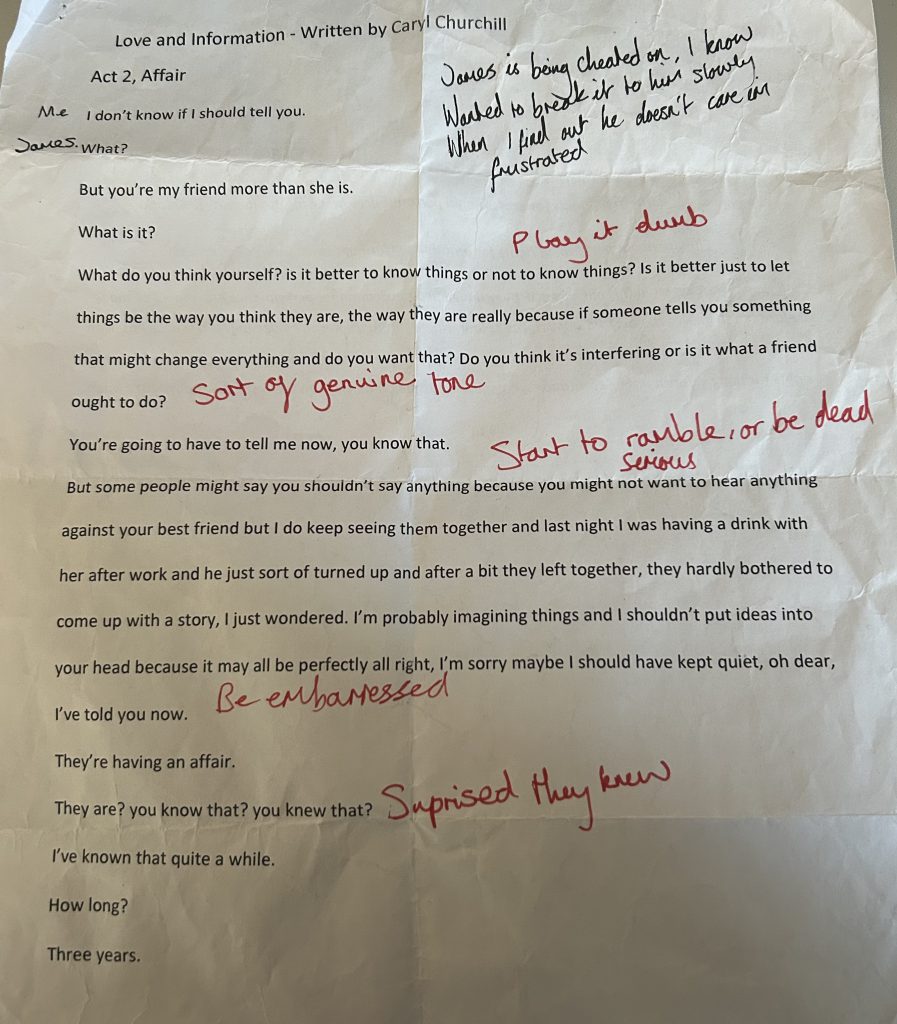
In one of our more recent actor and text lessons, Claire took us through the technique of line repetition—the idea of repeating a scene multiple times in different ways in order to “understand the difference between pretending to act and actually acting” (Woltman, 2023). It also allowed us to try different approaches to the scenes so we could adapt and build on them when we saw a significant change. As well as this, for me, it gives me lots of practice to work with the lines and try and find the inner meaning to them in order to show a convincing performance. The play that we worked a lot of our scenes on was from “Love and Information” (2023), and the stories were always left open to interpretation, which automatically for me meant that I had to be funny or entertain the class or just try and keep everyone engaged with the scene. But finding new ways to keep the audience engaged was very interesting to see. This was the moment when I began to delve into the more serious aspect of acting, as it was a new challenge for me and was also quite fun to push myself in a way I had done so rarely. During our line repetition lesson, I partnered with my classmate James, a good friend of mine yet someone who I hadn’t worked with yet, and it was really fun to use repetition in order to find ways that worked. Initially, we sat down and read through the script multiple times so that we could get a feel for each line and how we could go about it in performance. Once we had fully read it through, we discussed which lines could be done differently and changed the meaning of them. But then again we still found places in our work that either didn’t feel natural or serious, so we decided to repeat our lines with completely different intentions, and here we found a strong piece of work that we were ultimately really satisfied by. Instead of going down the slightly comedic route, we went for a full-on serious scene, which was definitely a challenge for us but was so fun to work through. What I also think helped with this was that I was with a close friend; therefore, I wasn’t afraid to take that extra step further within my work, whereas if I was with someone I didn’t know, I would feel hesitant to add some extra pieces to the performance. Once we had worked through the scene multiple times, we performed it in front of the class as well as Claire, which I found a little daunting, as the majority of my class hadn’t seen a more vulnerable, more emotional side to me, as that was the personality of the character I was playing. However, the scene gelled together really well, and we both got some top feedback, as they were sides the class hadn’t seen from us before, which was a great feeling. Since this lesson, I have incorporated line repetition in all of my work, as it is really beneficial for further development in text work. I thoroughly enjoyed learning this technique as it was described really well; it was a really good way to learn your lines as you are repeating them multiple times so they are engrained in your brain, and it helped us branch our intentions whilst going over our lines, which is always a positive! Overall i think that line repetition is a brilliant technique that is crucial in self and character development when performing new roles and scenes that are different to what you are often used to.
Hot Seating and Character Research.
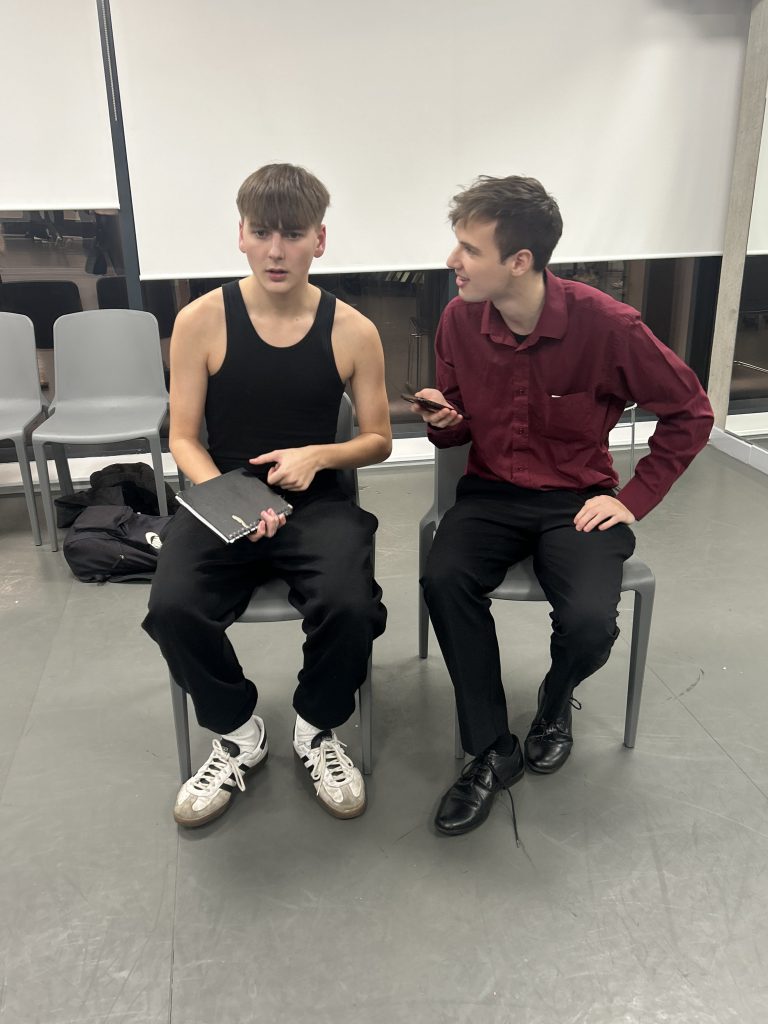
This was a very interesting technique and certainly a fun one. This technique is when an actor is typically sat in a chair and is asked questions in order to “deepen their understanding of their character” (Lynch, 2023). When we were introduced to this technique, the scripts we were given gave no backstory to our characters, so Claire gave us the task to come up with our own and practice hot seating with a partner. I partnered with my classmate, Ellie, and we discovered how useful this was when getting into character and how much it helps to embody your role. As well as this, we were told how hot seating can also link to character research, which is more of a side technique. For example, we were shown how making a character mind map is useful, as well as making music playlists and journaling, etc. This technique, for me, is one of the most important ones, as it is so vital to get into character and have those understandings about whichever role you could end up playing for however long.
Conclusion
In conclusion, I have deeply enjoyed all of the actor and text lessons. Being new to these types of lessons, I found every single technique so fascinating and was particularly riveted when seeing their effect in one’s performance. Despite there being times when I was either confused or didn’t understand these techniques, my teachers didn’t shy away from making it acceptable to ask questions, which really made the process easier. As a performer, I never realised how important these methods are and how evidential it is to see them in use, as well as the fact that I can now use these in my own performance. These skills should now be able to help ensure positive results within my future performances, as they are now engrained in my mind for whenever I next read a piece of text that I am to work on.
Bibliography
Ates, Alex. “The Definitive Guide to the Stanislavsky Acting Technique.” Backstage, 30 May 2023, www.backstage.com/magazine/article/the-definitive-guide-to-the-stanislavsky-acting-technique-65716/. Accessed 3 Jan. 2025.
Goodman, Ernest. “Tool # 1 SUPER OBJECTIVE, SCENE OBJECTIVE.” Directing Actors: Goodman Directing and Acting Studio, Los Angeles, 5 Nov. 2016, www.ernestgoodmanstudio.com/tool-1-super-objective-scene-objective/. Accessed 4 Jan
Hingley, Ronald Francis. “Anton Chekhov | Biography, Plays, Short Stories, & Facts.” Encyclopædia Britannica, 2019, www.britannica.com/biography/Anton-Chekhov. Accessed 5 Jan 2025
Lynch, Matthew. “What Is Hot Seating? – Pedagogue.” Pedagouge, 29 Jan. 2023, https://pedagogue.app/what-is-hot-seating/. Accessed 7 Jan 2025
McGowan, Elizabeth . “Actioning in Acting: A Full Guide.” Backstage.com, 3 Sept. 2022, www.backstage.com/magazine/article/actioning-acting-explained-75443/. Accessed 6 Jan 2025Woltmann, Suzy. “A
Guide to Meisner’s Repetition Exercise.” Backstage.com, 13 Mar. 2023, www.backstage.com/magazine/article/meisner-technique-exercises-76063/. Accessed 5 Jan. 2025
