
Attending Creative Practice sessions has influenced my musicianship and performance mindset vastly. Having the opportunity to liaise and work with peers on different courses in Leeds Conservatoire has constituted fruitful collaboration alongside personal enjoyment. As someone who appreciates all genres of music, it was a refreshing change to play and compose different types of pieces, with no constraint as to what was expected of us. However, I wanted to highlight one subject where it has particularly impacted me: my approach to performing music. This was primarily explored through our final five-week project, in which the ensemble decided to compose and experiment with a piece of dance music
We began our first session by establishing that we would incorporate technological elements. Instantly, I was confronted with a predicament, as my primary instrument (acoustic drum kit) did not align with this concept. Thankfully, I was presented with the idea from my lecturer of using a form of electric drums, in which I chose to embrace the challenge of learning the operation and functions of the Roland TR-8S Rhythm Performer. After identifying some basic chords, we mainly jammed throughout our first session, allowing productive experimentation and cooperation between the ensemble members. For my playing, I focused on providing a strong rhythmic pulse to outline the 4/4 time signature, as this would provide a clear tempo for the band members, but it also aligns with the conventions of the genre.
After review, I found the song very appealing and thought it suited our initial discussion incredibly well. Conversely, at the next session, as a group, we decided to move forward with a new and different motif and feel in the track as we desired to explore playing more dance music with different parameters. Key modifications included increasing the tempo, new structure and better understanding of our instrumental roles. Already my methodology had changed, due to knowing what was required of my instrument and how to operate it to a reasonable standard. This only increased throughout the following sessions. Together, we were able to work as a group and solicit feedback, allowing us to create an engaging dance track which we enjoyed pursuing.
My personal intention was to create points of rhythmic interest while maintaining the steady pulse the band needed. I conducted this by making sure the kick drum was played ‘four on the floor’ so that each beat of the bar was outlined clearly. When reflecting on our final recording, Sonny Martin (the guitarist in our group) commented: “I really loved how the song had this driving pulse throughout. The bass drums on each beat maintained that dancing energy we needed throughout.” This kind comment has shown me that this was the right approach to programming the drums for this kind of genre.
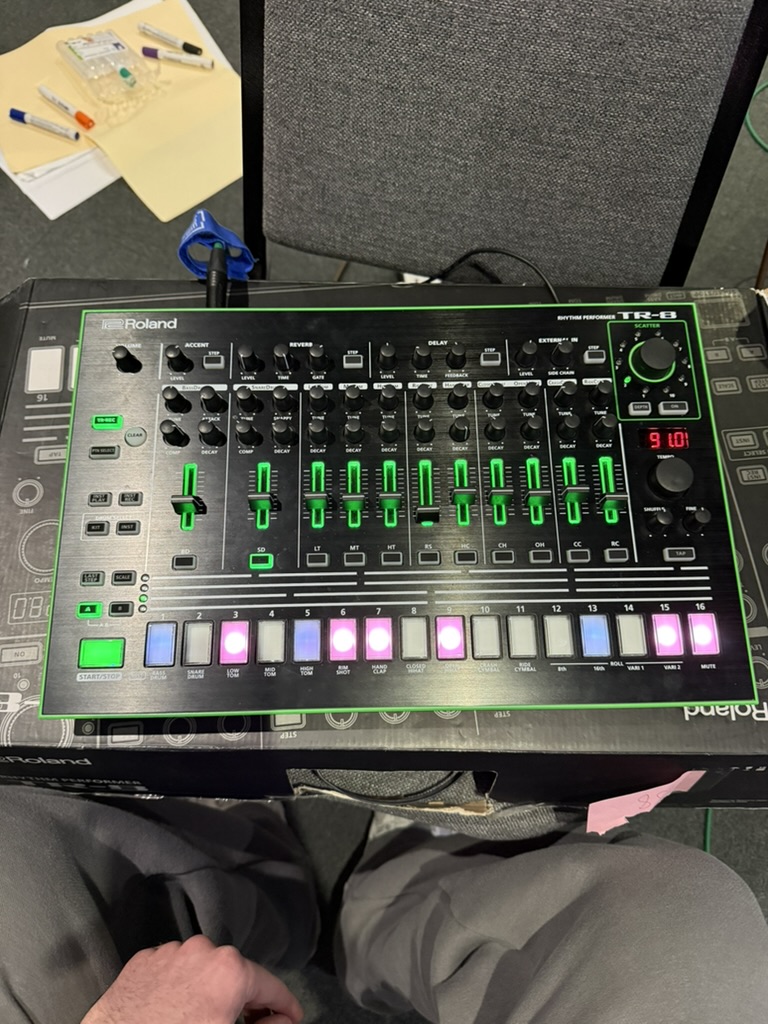
However, when talking to Ian Chow about the project he outlined “I think there could have been a little more variation when using the rhythm sequencer.” Although I had never used a drum sequencer before, or anything of similarity, I was able to adapt and comprehend the device promptly. I’m confident that this was due to my knowledge of the drums and rhythm proficiencies being translated to the TR-8S. Nevertheless, I completely agree with Ian’s statement. Providing variation through improvisation on the Roland was a huge struggle for me in this project. As a Jazz student, I am accustomed to improvisation, but not in this setting or with this genre of music. I am confident I struggled with improvisation in this context as I lacked knowledge of the layout. Despite the fact the interface is well-labelled, the abundance of buttons and dials caused minor confusion and hesitation when changing rhythms or faders in quick succession. On the other hand, I also believe my comfort zone stopped me from achieving this. Being presented with a completely new form of my instrument resulted in me not having my usual confidence. For this reason, I was not decisive in changing the sequences I created, as I was of the belief it could inconvenience the group. After reflecting, I comprehend that I should have taken a more creative and open-minded approach when experimenting in the dance groove and have taken opportunities to escape my comfort zone, following Ian’s feedback
Due to this project, I have become more interested in genres that use electronic-like drums but are played on an acoustic kit. One artist which has piqued my interest is Harry Ling, also known as ‘Mackwood’. “Mackwood has carved out a distinctive niche between progressive jazz, beatmaking and alternative dancefloor rhythms” (Ronnie Scott’s, no date). You can directly hear the similarities between his playing and the sound of drum machines when watching Mackwood perform his composition ‘Master Changes’ in which he trades solos with an electronic beat maker. When attempting to play some of this music myself, I now try to replicate what I was able to program on the Roland TR-8s, and apply it to a full kit, to create a more authentic electronic breakbeat or dance sound. This has been extremely effective as I have had positive comments from peers when using this approach in jazz jams and more formal group rehearsals.
Overall, Creative Practice has allowed me to develop my cognitive perception of playing music, especially when incorporating technology. I have found working in an ensemble of different pathway students fascinating and has allowed me to improve my musical playing and knowledge outside of the jazz genre. To continue my studies into the topics from this project, I want to study drummers including Richard Spaven and Derrick Mackenzie to hear their views and approaches on playing vastly different technologically influenced music.
Bibliography:
Ronnie Scott’s. (No date) Available at: https://www.ronniescotts.co.uk/find-a-show/mackwood [Accessed 10th May 2026].
Sghetto. (2025) Mackwood – Master Changes | live! Sghetto Club [Online]. Available at: https://www.youtube.com/watch?v=34IcbfB_YYE [Accessed 9th May 2026].
Mackwood, L. (2024) Master Changes [Online], Master Changes, 5dB Records. Available at: https://open.spotify.com/track/43b0Pmkf60BWCBrD2ToLjX?si=9dcd1d3bf93b42b4 [Accessed 9th May 2026].
