
This essay documents my learning process during my Intercultural Music Project. This began with the basics of what interculturalism is. Throughout this project, I found collaboration and the exchange of musical traditions to be central to what intercultural music represents. The study is relevant as it “affords opportunities for understanding and social cohesion [which] has shaped policy and media discourse” (Crooke et al., 2023).
Initially, the project began as a research-based exploration into music from different cultures, but it gradually developed into a deeper understanding of both my own cultural identity and music theory as a whole. In particular, the project focused on the inclusion of Indian Classical Music within my own musical practice and future creative works.
Prior to this project, most of my musical experience was rooted in Western pop, indie and Classical traditions, meaning I was more familiar with conventional harmonic structures and songwriting techniques. However, studying Indian Classical music challenged my understanding of rhythm, harmony, and melody due to its intricate polyrhythms, improvisational nature, and emphasis on scalic melodies. I also explored how these ideas could be incorporated alongside Western songwriting compositional approaches within my own music-making process.
Although I initially faced difficulties in both understanding and practical application, Indian Classical music had the greatest impact on my creative output because of its cultural significance within my family and upbringing. Exploring this tradition allowed me to reconnect with aspects of my heritage while broadening my musical language and compositional style. This essay will evaluate my research into intercultural music, analyse how these influences informed my 6-minute recorded performance, and reflect on how the project has shaped my future musical practice and creative identity.
Initial Musical Background and Expectations
Prior to the beginning of this project, my songwriting and production style largely followed a conventional verse – chorus structure, built around repetitive harmonic cycles, lyric-centred writing, and floaty melodic phrasing. My experience within Western popular music had been heavily influenced by soul and jazz, particularly through atmospheric arrangements, expressive vocal delivery, and the use of extended jazz harmonies. See Appendix 1 for an example of my earlier musical style.
My creative process often begins with a simple four-chord progression, gradually layering textures and instrumentation to build atmosphere throughout the song. Because of this approach, I naturally became interested in combining multiple genres within a single composition, which later encouraged a curiosity towards music from different cultures.
As a singer-songwriter, I was most familiar with acoustic instrumentation, conventional harmonic movement, and storytelling through lyrics. Rhythm generally functioned as a supportive element within my music rather than acting as the primary focus. In contrast, Indian Classical Music introduced theories that relied more heavily on rhythmic complexities, improvisation, and ornamentation. These concepts differed significantly from the Western compositional techniques I had previously relied upon.
This became an assumed limitation within my practice, as rhythm and improvisation had not previously been strong areas for me. During workshop sessions, I found the group-based exercises particularly challenging, especially when attempting Konnakol and navigating unfamiliar rhythmic functions. Considerable practice was required to develop confidence and accuracy within these exercises. See Appendix 2 for documentation of my first attempt at Konnakol alongside my classmates.
Alongside the practical difficulties, I also struggled to separate my learning from a Western theoretical framework. I had become accustomed to understanding music through harmonic progression and chord-based structure. Indian Classical music instead prioritised melodic development, cyclical rhythm, and improvisational expression, which challenged many of my previous assumptions surrounding composition and performance.
Over time, these challenges became central to the aims of the project itself. Through research and experimentation, I became increasingly interested in developing a broader compositional language informed by both Western and Indian musical traditions. I hoped to gain a deeper understanding of my cultural background while discovering ways to incorporate these influences authentically into my own artistic identity. Another important objective was improving my skills in vocal ornamentation and improvisation, both of which are heavily utilised within Indian Classical performance practice. Ultimately, the project encouraged me to challenge my existing habits and develop a more flexible and culturally informed creative approach.
Research Into Intercultural Practices
The main culture explored was Indian Classical practices. Specifically, Konnakol rhythms and Hindustani Raga improvisations. These were the features I utilised within my 6 minute performance. This, alongside a more indie song, would interweave to create a lyrical and sonically intricate song.
“The origins of Indian classical music lie in the cultural and spiritual values of India…The art of music was regarded as holy and heavenly.. Subsequently this art branched off into three separate streams: vocal music (geet), instrumental music (vadya), and dancing (nritya)” [Chakraborty et al, 2014]. Western interest in Indian music has changed over time, beginning with early approaches that often misrepresented or simplified Indian musical traditions. In the 18th and 19th centuries, Indian music was commonly viewed through an “Orientalist” lens, where it was interpreted using Western cultural assumptions that sometimes distorted its original meaning and context. However, from the late 20th century onwards, there has been a shift towards more genuine engagement and influence, with elements of Indian music being incorporated into Western popular music. Creating that shift are musicians such as “Carnatic vocalists Ranjani and Gayatri [who] have ventured into fusion music while remaining deeply rooted in classical traditions. Their work with fusion often centers on bridging Carnatic music with broader musical elements, emphasizing the versatility of ragas and Carnatic idioms to reach diverse audiences” [Yamini Krishna and Saileswari, 2025]
One of the most significant aspects of Indian Classical Music that challenged my understanding of composition was its approach to rhythm and metric structure. Unlike Western popular music, where rhythm often supports melody and harmony, Indian Classical traditions place rhythmic organisation at the centre of musical performance and improvisation. “Tala, in the music of India, Bangladesh, and Pakistan, is a metric cycle with a specific number of beats – from 3 to 128 – that recur in the same pattern throughout a musical performance.” [Nettl, 2022] Both the tala and konnokol are south Indian derived music composition methods which both utilise the element of timing. Tala within Indian tradition is the “principal musician” [Rao, n.d], that while carrying the musical meter of the song “does not exercise a regularly recurring pattern” Likewise the konnokol is also metric based in the sense that rather than notation, singers use konnokol to create “complex compositions based on mathematical patterns” [McLean, 2024]. The link between these two is their metric nature. Both are said to be of an improvisatory nature; “building up an internal pulse” with the konnokol and the “tala system” having multiple variations of symbols and the amount of times they are sung being the main driving force behind its success.
Whilst Carnatic rhythms originated in the south of India, Hindustani ragas are the foundation of North Indian classical music. The raga forms the basis of the melodic content in Indian classical music. It is a scale, seven notes in length, with specific rules for approaching each tone depending on whether the performer is ascending or descending. These may include specific ornamentations attached to particular notes. Similar to the Western Do Re Me Fa Sol La Ti, the syllables of the raga are abbreviated as Sa, Re, Ga, Ma, Pa, Dha and Ni. Sa and Pa (which are the I and V of the raga) are unalterable: the rest can be flattened, apart from Ma which can be sharpened. Ornamentation of the notes, refers to the manner in which the notes are linked and embellished.
There are multiple features of the raga, and how it is performed that influence the texture, and more effectively, the structures of the piece. The Alap is the introduction, although it can last for an hour. It consists of a drone being played by the tanpura as the performer introduces the raga in free-time, first descending and then ascending exploring the entire range of the instrument. The Gat is marked by the entrance of the drums (tabla in Hindustani music), which outline the tala. According to Mathur et al, “distinct emotional responses are associated with the alaap and gat of a raga.” In the study, the researchers found that the two main performance sections of a raga produce different emotional effects in listeners. The alaap is slow, unmetered, and focused on gradual melodic exploration, which tends to create calmer or more reflective emotional states. In contrast, the gat introduces a steady rhythmic cycle and faster tempo, often leading to stronger or more energised emotional responses. This means that the emotional meaning of a raga is not fixed, but is shaped by its structure and progression over time. [Mathur et al, 2015].
Although the emotional response of the Raga changes, the Raga Guide [Bor and Rao, 2002] demonstrates how Hindustani ragas are associated with distinct emotional atmospheres and expressive characteristics, Each raga functions as a unique melodic framework designed to evoke particular moods, times of day, and emotional responses through improvisation and ornamentation.
In contrast to Indian Classical Music, Western singer-songwriter traditions are often structured around lyrical storytelling, harmonic progression, and accessible song forms such as verse chorus arrangements. Within these Western styles, emotion is frequently communicated through lyrics, chord changes, and vocal intimacy, whereas Indian Classical music places greater emphasis on rhythmic complexity, improvisation, and ornamentation, utilising the raga, tala, and drone textures to create emotional atmosphere and tension over extended periods of time.
Despite their differences, both traditions share an expressive and emotionally driven quality that became increasingly prevalent throughout my research process. Whilst I am confident in my ability to express an emotion through storytelling, Indian Classical music encouraged a more fluid and improvisatory understanding of melody and rhythm. Through combining aspects of both styles, I began developing a more flexible creative approach that reflected both my musical influences and cultural heritage.
Influence on my own creative practice
Following my research into Indian musical practices and their contrast with the Western traditions I had been exposed to from a young age, I became interested in combining elements of both within a single composition. To begin this process, I analysed the most relevant elements of music in order to better understand the differences and potential connections between the two styles. The main focus lent itself to rhythm and harmony. Due to this fact, the main two theories of Indian Classical music that I applied instinctively to the 6 minute recorded performance were the use of the raga, and tala. I also aimed to sustain a singular emotional atmosphere throughout the song, as this felt important to the lyrical narrative and melodic development. As well as creating a storyline through lyrics alone, I wanted the overall atmosphere and emotional character of the song to evolve through melody, texture, and performance. This led me to explore which raga would best support the mood and narrative I intended to communicate.
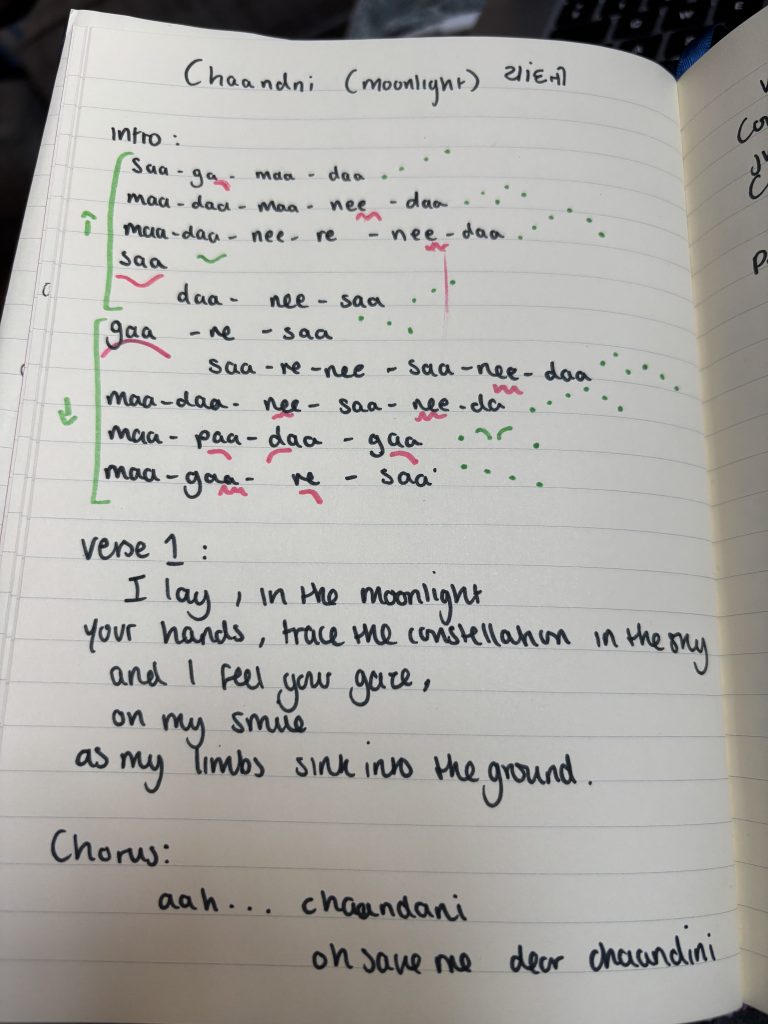
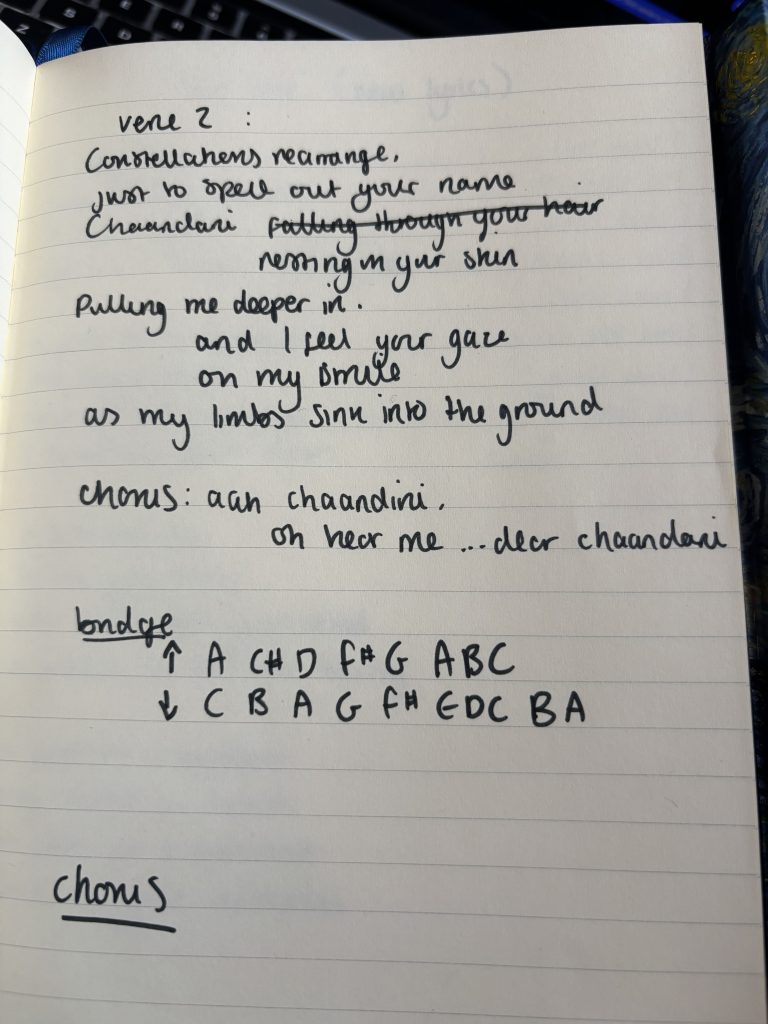
After further research, I chose Raag Bageshree due to its introspective, romantic, and late-night emotional qualities. The Raga “emerges like a conversation between the soul and its beloved. It is a raga of “Viraha” (longing) and “Shringar” (romance), traditionally described as a woman waiting for her lover’s return.” [Kalasudha.com, 2021] The emotional character associated with the raga aligned closely with the reflective atmosphere I wanted the song to convey. Following the discovery of the raga, the title of the song developed naturally. I chose the name Chaandini, meaning “moonlight” in English, a word I was already familiar with through Hindi lessons during childhood. This connection made the composition feel more personal, allowing the project to become not only a musical exploration but also a reflection of my cultural heritage and identity. Appendix 3 shows my written out lyrics.
Appendix 3 also demonstrates how I planned the introduction. This, being the Alaap, was in free-time and sung over a drone. The syllables highlighted in pink indicate where vocal ornamentation and tonal inflections would be performed, helping to reflect stylistic elements of Indian Classical Music. Additionally, the green markings alongside the notation were used as a visual method of memorising the ascending and descending movement of the raga. In contrast to the planned out melodic movement of my introduction, I utilised the common Indian Classical approach of improvisation to allow free expression within the chorus. Due to this, I only used the lyrics written as a guide and improvised on the recording. “This improvisational element is a defining feature, allowing performers to explore the depths of a raga (melodic framework) and tala (rhythmic cycle) in unique and personal ways.” [Team, 2024]
Instrumentation was partly shaped by the resources and musicians I had access to throughout the project. Due to the personal nature of the song, I wanted the arrangement to remain acoustic, which centred the performance around voice and guitar. See Appendix 4 to hear the simple guitar loop I wrote with the chords, D, Am, Em, A(b9), Am(b9). Alongside this, I knew it was important to incorporate a sustained drone texture, as drones are a significant feature within Indian Classical Music and contribute heavily to atmosphere and tonal grounding.
Having previously collaborated with a cellist in earlier performances, I recognised that the flexibility and expressive qualities of a string instrument would allow aspects of Indian Classical performance practice to be explored more effectively. Through the use of slides and sustained double stopping, the fretless cello was able to create a continuous humming drone throughout most of the composition, with the exception of the bridge section.
The second focal point of the intercultural project developed in collaboration, during rehearsals we created our bridge which would showcase the use of tala. The guitarist plays in 4/4 time signature until the last run through when he joins me in triplets. To keep time I am using the Konnakol syllables, Tha – Kha – Dhi – Mi, in 4s and Tha – Kha – The in triplets which is further emphasised by the hand clapping motion. There is a moment within the bridge that myself and the guitarist display a 4 3 polyrhythm. During this rhythmically challenging moment, the cellist changes from the consistent drone, to finger picking. He improvises the raga over the tala. This creates a build in textures and tension, which leads in perfectly to the release of the final chorus.
Reflection on Learning and future practice
Throughout this project, I developed both musically and creatively through engaging with unfamiliar music theories within an intercultural collaboration. Prior to the project, my songwriting relied heavily upon Western traditions, however upon researching and applying elements of Indian Classical Music, it has encouraged me to rethink how emotion and atmosphere can be communicated through rhythm, melody, improvisation, and texture.
One of the most significant developments was my understanding of rhythm and improvisation. Learning tala and Konnakol challenged me to approach rhythm in a more precise way, strengthening my performance awareness. Similarly, experimenting with raga improvised melodies allowed me to move beyond fixed melodic phrasing.
The project also presented challenges and limitations due to my understanding thus far. With further research and consistent practice, the use of ragas and tala rhythms should become more natural rather than the forced nature of my recorded performance. I aimed to balance the authenticity of the intercultural aspects with creative interpretation, meaning that I wanted to respectfully incorporate elements of Indian Classical Music into my own music without directly imitating or misrepresenting the tradition itself. I recognise that my initial understanding of some of the more complex rhythmic and melodic structures within Indian Classical Music was still developing throughout the project, which meant that my application of certain intercultural elements was sometimes less incorporated.
Ultimately, this project broadened both my listening habits and compositional thinking. Moving forward, I intend to continue exploring intercultural collaboration and incorporating improvisation, drone textures, and rhythmic experimentation into my future musical practice.
Conclusion
Through studying Indian Classical Music alongside Western singer-songwriter traditions, I gained insight into contrasting approaches to rhythm, melody and improvisation. These discoveries directly shaped the development of my recorded performance of the song, Chaandini (moonlight). The use of Raag Bageshree informed the emotional atmosphere and melodic movement of the composition, while techniques such as improvisation, vocal ornamentation, tala-based rhythmic ideas, and sustained drone textures allowed Indian Classical influences to exist alongside the singer-songwriter elements.
Beyond the performance, the project has had a lasting influence on my wider creative practice. It encouraged me to approach composition more openly and experimentally, placing greater emphasis on atmosphere, texture, and rhythmic development within my songwriting. The project also highlighted the importance of thoughtful intercultural engagement within contemporary music-making. Moving forward, I intend to continue incorporating intercultural collaboration into future projects as part of an evolving and culturally informed artistic identity.
Bibliography
Bor, J. and Rao, S. (2002). The raga guide : a survey of 74 Hindustani ragas. Monmouth: Wyastone Estate.
Chakraborty, S., Mazzola, G., Tewari, S. and Patra, M. (2014). An Introduction to Indian Classical Music. Computational music science, pp.1–14.
Crooke, A.H.D., Thompson, W.F., Fraser, T. and Davidson, J. (2023). Music, Social cohesion, and Intercultural understanding: A Conceptual Framework for Intercultural Music Engagement. Musicae Scientiae, 28(1).
Kalasudha.com. (2021). Bageshri | KalaSudha. [online] Available at: https://kalasudha.com/raga/bageshri [Accessed 5 May 2026].
Mathur, A., Vijayakumar, S.H., Chakrabarti, B. and Singh, N.C. (2015). Emotional responses to Hindustani raga music: the role of musical structure. Frontiers in Psychology, 6.
McLean, A. (2024). Konnakol rhythms. Algorithmic Pattern. [online] Available at: https://alpaca.pubpub.org/pub/ofzrb3a6/release/12 [Accessed 3 May 2026].
Nettl, B. (2022). Tala | music. [online] Encyclopedia Britannica. Available at: https://www.britannica.com/art/tala.
Rao, D. (n.d.). Tala and its significance. [online] Available at: https://naadnartan.in/wp-content/uploads/2023/06/D.-Anantha-Rao-1.pdf.
Team, S. (2024). The Role of Improvisation in Indian Classical Music. [online] Serenade. Available at: https://serenademagazine.com/the-role-of-improvisation-in-indian-classical-music/.
Yamini Krishna, K. and Saileswari, R.N.S. (2025). View of The Impact of Indian Classical Music on Present Society. [online] Jyanavispmvv.in. Available at: https://jyanavispmvv.in/index.php/files/article/view/21/14 [Accessed 12 May 2026].
Appendix
Appendix 1: Example of earlier music style
Appendix 2: Documentation of my first attempt at Konnakol
Appendix 3: Pages of Lyrics / Plan
Appendix 4: Guitar loop
